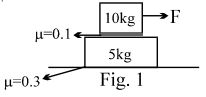
A $1.0 kg$ block of wood sits on top of an identical block of wood, which sits on top of a flat level table made of plastic. The coefficient of static friction between the wood surfaces is $\mu_1$, and the coefficient of static friction between the wood and plastic is $\mu_2$. Ahorizontal force $F$ is applied to the top block only, and this force is increased until the top block starts to move. The bottom block will move with the top block if and only if
Diffcult


Download our appand get started for free
Experience the future of education. Simply download our apps or reach out to us for more information. Let's shape the future of learning together!No signup needed.*
Similar Questions
- 1The acceleration of $10\, kg$ block when $F = 30\,N$ ........ $m/s^2$View Solution
- 2Assuming the coefficient of friction between the road and tyres of a car to be $0.5$, the maximum speed with which the car can move round a curve of $40.0\, m$ radius without slipping, if the road is unbanked, should be ......... $m/s$View Solution
- 3A block of mass $m$ slides down the plane inclined at angle $30^{\circ}$ with an acceleration $\frac{ g }{4}$. The value of coefficient of kinetic friction will be :View Solution
- 4A block weighs $W$ is held against a vertical wall by applying a horizontal force $F$. The minimum value of $F$ needed to hold the block isView Solution
- 5A heavy box is to dragged along a rough horizontal floor. To do so, person $A$ pushes it at an angle $30^o$ from the horizontal and requires a minimum force $F_A$, while person $B$ pulls the box at an angle $60^o$ from the horizontal and needs minimum force $F_B$. If the coefficient of friction between the box and the floor is $\frac{{\sqrt 3 }}{5}$ , the ratio $\frac{{{F_A}}}{{{F_B}}}$ isView Solution
- 6Two blocks $A$ and $B$ of masses $5 \,kg$ and $3 \,kg$ respectively rest on a smooth horizontal surface with $B$ over $A$. The coefficient of friction between $A$ and $B$ is $0.5$. The maximum horizontal force (in $kg$ wt.) that can be applied to $A$, so that there will be motion of $A$ and $B$ without relative slipping, isView Solution
- 7A block of mass $1\, kg$ is at rest on a horizontal table. The coefficient of static friction between the block and the table is $0.5.$ The magnitude of the force acting upwards at an angle of $60^o$ from the horizontal that will just start the block moving isView Solution
- 8A car is moving with a constant speed of $20\,m / s$ in a circular horizontal track of radius $40\,m$. A bob is suspended from the roof of the car by a massless string. The angle made by the string with the vertical will be : (Take $g =10$ $\left.m / s ^2\right)$View Solution
- 9A cyclist moves in a circular track of radius $100$ m. If the coefficient of friction is $0.2$, then the maximum velocity with which the cyclist can take the turn with leaning inwards is ...... $m/s$View Solution
- 10In the given figure the acceleration of $M$ is $(g = 10 \,ms^{-2})$View Solution