A block weighs $W$ is held against a vertical wall by applying a horizontal force $F$. The minimum value of $F$ needed to hold the block is
Medium
Download our app for free and get started
(c) Here applied horizontal force $F$ acts as normal reaction.
For holding the blockForce of friction = Weight of block
$f = W$ $⇒$ $\mu \,R = W$ $⇒$ $\mu \,F = W$
$⇒$ $F = \frac{W}{\mu }$ As $\mu < 1$
$\therefore \;\;\;F > W$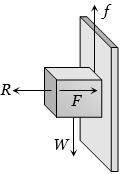

Download our appand get started for free
Experience the future of education. Simply download our apps or reach out to us for more information. Let's shape the future of learning together!No signup needed.*
Similar Questions
- 1In figure, two blocks $M$ and $m$ are tied together with an inextensible and light string. The mass $M$ is placed on a rough horizontal surface with coefficient of friction $\mu$ and the mass $m$ is hanging vertically against a smooth vertical wall. The pulley is frictionless. When the downward acceleration of the elevator becomes equal to $g$, thenView Solution

- 2A road is banked at an angle of $30^o$ to the horizontal for negotiating a curve of radius $10\sqrt 3 m$. At what velocity will a car experience no friction while negotiating the curve? ............... $km/hr$View Solution
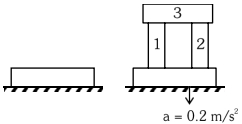
- 3A steel block of $10\, {kg}$ rests on a horizontal floor as shown. When three iron cylinders are placed on it as shown, the block and cylinders go down with an acceleration $0.2\, {m} / {s}^{2}$. The normal reaction ${R}$ by the floor if mass of the iron cylinders are equal and of $20\, {kg}$ each, is .....$N.$ [Take ${g}=10\, {m} / {s}^{2}$ and $\mu_{{s}}=0.2$ ]View Solution
- 4A particle of mass $m$ is at rest at the origin at time $t = 0$. It is subjected to a force $F(t) = F_0e^{-bt}$ in the $x$ -direction. Its speed $v(t)$ is depicted by which of the following curves ?View Solution
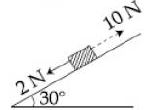
- 5A block kept on a rough inclined plane, as shown in the figure, remains at rest upto a maximum force $2\,N$ down the inclined plane. The maximum external force up the inclined plane that does not move the block is $10\,N.$ The coefficient of static friction between the block and the plane is : [Take $g = 10\,m/s^2$ ]View Solution
- 6A car is moving with a constant speed of $20\,m / s$ in a circular horizontal track of radius $40\,m$. A bob is suspended from the roof of the car by a massless string. The angle made by the string with the vertical will be : (Take $g =10$ $\left.m / s ^2\right)$View Solution
- 7A girl holds a book of mass $m$ against a vertical wall with a horizontal force $F$ using her finger, so that the book does not move. The frictional force on the book by the wall isView Solution
- 8A block of mass $M$ rests on a rough horizontal table. A steadily increasing horizontal force is applied such that the block starts to slide on the table without toppling. The force is continued even after sliding has started. Assume the coefficients of static and kinetic friction between the table and the block to be equal. The correct representation of the variation of the frictional force $f$, exerted by the table on the block with time $t$ is given byView Solution
- 9$A$ block of mass $M$ is placed on $a$ horizontal surface and it is tied with an inextensible string to $a$ block of mass, as shown in figure. A block of mass $m_0$ is also placed on $M$ If $\mu < \mu_{min}$ (the minimum friction required to keep the block $m$ stationary), then the downward acceleration of $m$ isView Solution

- 10A railway line is taken round a circular arc of radius $1000\ m$, and is banked by raising the outer rail $h\ m$ above the inner rail. If the lateral force on the inner rail when a train travels round the curve at $10 \ ms^{-1}$ is equal to the lateral force on the outer rail when the train's speed is $20\ ms^{-1}$. The value of $4g\ tan\theta$ is equal to : (The distance between the rails is $1.5 \ m$).View Solution