MCQ
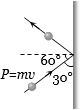
A $100\, g$ iron ball having velocity $10 \,m/s$ collides with a wall at an angle $30^°$ and rebounds with the same angle. If the period of contact between the ball and wall is $0.1\, second$, then the force experienced by the wall is  ........... $N$
  • $10$
  • B
    $100$
  • C
    $1.0$
  • D
    $0.1$

Answer

Correct option: A.
$10$
a
(a) During collision of ball with the wall horizontal momentum changes (vertical momentum remains constant)

$\therefore F = \frac{{{\rm{Change\, in\, horizontal\, momentum }}}}{{{\rm{Time \,of \,contact}}}}$

$ = \frac{{2P\cos \theta }}{{0.1}} = \frac{{2mv\cos \theta }}{{0.1}}$

$ = \frac{{2 \times 0.1 \times 10 \times \cos 60^\circ }}{{0.1}}$$ = 10\;N$

Need a full question paper?

Generate a complete, print-ready paper with questions like this in minutes — across 16+ boards, with answer keys.

Start Generating Free

Similar questions

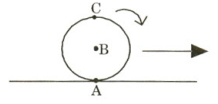
A sphere is rolling without slipping on a fixed horizontal plane surface. In the figure, $\mathrm{A}$ is the point of contact, $\mathrm{B}$ is the centre of the sphere and $\mathrm{C}$ is its topmost point. Then,

$(A)$ $\vec{V}_C-\vec{V}_A=2\left(\vec{V}_B-\vec{V}_C\right)$

$(B)$ $\vec{V}_C-\vec{V}_B=\vec{V}_B-\vec{V}_A$

$(C)$ $\left|\vec{V}_C-\vec{V}_A\right|=2\left|\vec{V}_B-\vec{V}_C\right|$

$(D)$ $\left|\vec{V}_C-\vec{V}_A\right|=4\left|\vec{V}_B\right|$

The specific heat at constant volume for the monoatomic argon is $0.075\, kcal/kg-K,$ whereas its gram molecular specific heat ${C_V}$ $= 2.98\, cal/mole/K.$ The mass of the argon atom is

$(Avogadro’s \,number = 6.02 \times {10^{23}}\,molecules/mole)$

The velocity $v$ (in $cm/\sec $) of a particle is given in terms of time $t$ (in sec) by the relation $v = at + \frac{b}{{t + c}}$ ; the dimensions of $a,\,b$ and $c$ are
A satellite of mass $m$ is orbiting the earth $($of radius $R)$ at a height $h$ from its surface. The total energy of the satellite in terms of $g_0$, the value of acceleration due to gravity at the earth's surface, is 
The upper end of a wire of radius $4\ mm$ and length $100\ cm$ is clamped and its other end is twisted through an angle of $30^\circ .$ The angle of shear is:
The volume $V$ of a given mass of monoatomic gas changes with temperature $T$ according to the relation $V = KT ^{2 / 3}$. The workdone when temperature changes by $90\, K$ will be $x\,R$. The value of $x$ is $[ R =$ universal gas constant $]$
The pressure of a gas filled in the bulb of a constant volume gas thermometer at temperatures $0^{\circ} C$ and $100^{\circ} C$ are $27.50 \,cm$ and $37.50 \,cm$ of $Hg$ respectively. At an unknown temperature the pressure is $32.45 \,cm$ of $Hg$. Unknown temperature is ........ $^{\circ} C$
A man (mass $= 50\, kg$) and his son (mass $= 20\, kg$) are standing on a frictionless surface facing each other. The man pushes his son so that he starts moving at a speed of $0.70\, ms^{-1}$ with respect to the man. The speed of the man with respect to the surface is ........ $ms^{-1}$
The conclusion of Bernoulli's theorem is:
An ideal gas, initially in state $\left( P _{12}, V _1, T _1\right)$ is expanded isobarically to $\left( P _{12}, V _2, T _2\right)$, then adiabatically $\left( P _{34}, V _3, T _3\right)$. It is then contracted isobarically to $\left( P _{34}, V _4, T _4\right)$ and finally adiabatically back to the initial state. The efficiency of this cycle is