A $5\, m$ long aluminium wire ($Y = 7 \times {10^{10}}N/{m^2})$ of diameter $3\, mm$ supports a $40\, kg$ mass. In order to have the same elongation in a copper wire $(Y = 12 \times {10^{10}}N/{m^2})$ of the same length under the same weight, the diameter should now be, in $mm.$
Diffcult


Download our appand get started for free
Experience the future of education. Simply download our apps or reach out to us for more information. Let's shape the future of learning together!No signup needed.*
Similar Questions
- 1A boy’s catapult is made of rubber cord which is $42\, cm$ long, with $6\, mm$ diameter of cross -section and of negligible mass. The boy keeps a stone weighing $0.02\, kg$ on it and stretches the cord by $20\, cm$ by applying a constant force. When released, the stone flies off with a velocity of $20\, ms^{-1}$. Neglect the change in the area of cross section of the cord while stretched. The Young’s modulus of rubber is closest toView Solution
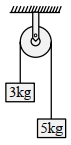
- 2Two blocks of masses $3 \,{kg}$ and $5\, {kg}$ are connected by a metal wire going over a smooth pulley. The breaking stress of the metal is $\frac{24}{\pi} \times 10^{2}\, {Nm}^{-2}$. What is the minimum radius of the wire? (Take $\left.g=10\, {ms}^{-2}\right)$ (in $cm$)View Solution
- 3Work done by restoring force in a string within elastic limit is $-10 \,J$. Maximum amount of heat produced in the string is .......... $J$View Solution
- 4View SolutionOn stretching a wire, the elastic energy stored per unit volume is
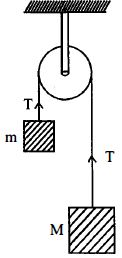
- 5Two blocks of masses $m$ and $M$ are connected by means of a metal wire of cross-sectional area $A$ passing over a frictionless fixed pulley as shown in the figure. The system is then released. If $M = 2\, m$, then the stress produced in the wire isView Solution
- 6The length of wire becomes $l_1$ and $l_2$ when $100\,N$ and $120\,N$ tensions are applied respectively. If $10l_2=11l_1$, the natural length of wire will be $\frac{1}{x} l_1$. Here the value of $x$ is ........View Solution
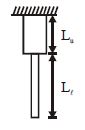
- 7A composite heavy rope of two materials is suspended vertically from a high ceiling. The ratios of different quantities for upper to lower rope are length $\frac{{{L_u}}}{{{L_l}}} = \frac{1}{2}$ , cross sectional area $\frac{{{A_u}}}{{{A_l}}} = \frac{2}{1}$ ,density $\frac{{{d_u}}}{{{d_l}}} = \frac{2}{3}$ .What is the ratio of maximum stress in the two ropesView Solution
- 8If $\rho $ is the density of the material of a wire and $\sigma $ is breaking stress, the greatest length of the wire that can hang freely without breaking isView Solution
- 9A wire of diameter $1mm$ breaks under a tension of $1000\, N.$ Another wire, of same material as that of the first one, but of diameter $2\, mm$ breaks under a tension of ...... $N$View Solution
- 10View SolutionDue to addition of impurities, the modulus of elasticity