Question
A 5.0 diopter lens forms a virtual image which is 4 times the object placed perpendicularly on the principal axis of the lens. Find the distance of the object from the lens.
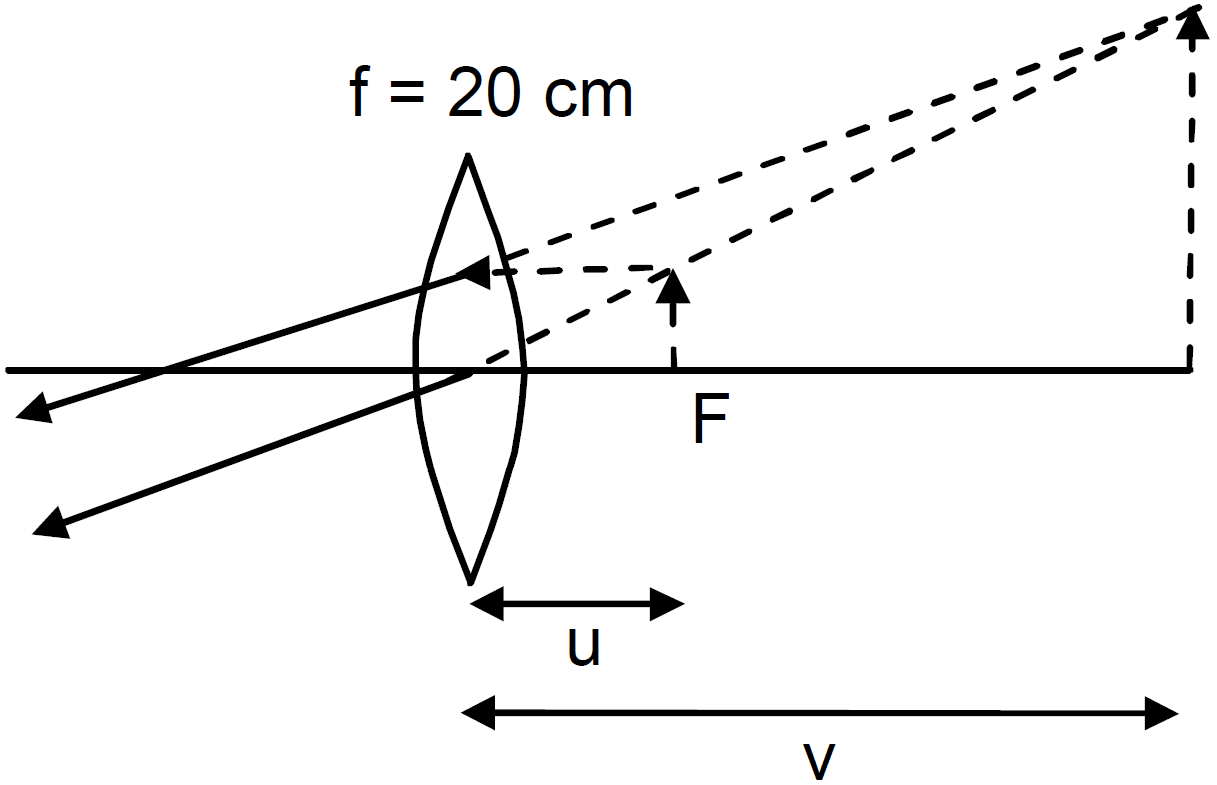
Answer


Given, P = 5 diopter (convex lens)
$\Rightarrow\text{f}=\frac{1}{5}\text{m}=20\text{cm}$
Since, a virtual image is formed, u and v both are negative.Given, $\frac{\text{v}}{\text{u}}=4$
$\Rightarrow\text{v}=4\text{u} \ ...(1)$
From lens formula, $\frac{1}{\text{v}}-\frac{1}{\text{u}}=\frac{1}{\text{f}}$
$​​\Rightarrow\frac{1}{\text{f}}=\frac{1}{4\text{u}}-\frac{1}{\text{u}}​​\Rightarrow\frac{1}{20}=\frac{1-4}{4\text{u}}=-\frac{3}{4\text{u}}$
$\Rightarrow\text{u}=-15\text{cm}$
$\therefore$ Object is placed 15cm away from the lens.

Need a full question paper?

Generate a complete, print-ready paper with questions like this in minutes — across 16+ boards, with answer keys.

Start Generating Free

Similar questions

The conductivity of a pure semiconductor is roughly proportional to $\text{T}^\frac{3}{2}\text{e}^{\frac{-\Delta\text{E}}{2\text{kT}}}$ where $\Delta\text{E}$ is the band gap. The band gap for germanium is 0.74eV at 4K and 0.67eV at 300K. By what factor does the conductivity of pure germanium increase as the temperature is raised from 4K to 300K?
The focal lengths of a convex lens for red, yellow and violet rays are 100cm, 98cm and 96cm respectively. Find the dispersive power of the material of the lens.
What is the kinetic energy of an electron in electronvolts with mass equal to double its rest mass?
Sketch a graph between frequency of incident radiations and stopping potential for a given photosensitive material. What information can be obtained from the value of the intercept on the potential axis? A source of light of frequency greater than the threshold frequency is placed at a distance of 1 m from the cathode of a photo-cell. The stopping potential is found to be V. If the distance of the light source from the cathode is reduced, explain giving reasons, what change will you observe in the.
  1. photoelectric current,
  2. stopping potential.
The radius of gyration of a uniform disc about a line perpendicular to the disc equals its radius. Find the distance of the line from the centre.
The ground state energy of hydrogen atom is –13.6 eV.
  1. What is the kinetic energy of an electron in the 2nd excited state?
  2. If the electron jumps to the ground state from the 2nd excited state, calculate the wavelength of the spectral line emitted.
Whenever a photon is emitted by hydrogen in Balmer series, it is followed by another photon in Lyman series. What wavelength does this latter photon correspond to?
A 2 in long string fixed at both ends is set into vibrations in its first overtone. The wave speed on the string is 200m/s and thee amplitude is 0.5cm.
  1. Find the wavelength and the frequency.
  2. Write the equation giving the displacement of different points as a function of time. Choose the X-axis along the string with the origin at one end and t = 0 at the instant when the point x = 50cm has reached its maximum displacement.
Boron has two stable isotopes, $^{10}_5\text{B }\text{ and }\ ^{11}_5\text{B}.$ Their respective masses are 10.01294 u and 11.00931 u, and the atomic mass of boron is 10.811 u. Find the abundances of $^{10}_5\text{B }\text{ and }\ ^{11}_5\text{B}.$
Explain the principle, construction, working and application of moving coil galvanometer.