A $500 \,\mu F$ capacitor is charged at a steady rate of $100\, \mu C/sec$. The potential difference across the capacitor will be $10\, V$ after an interval of.....$sec$
Medium
Download our app for free and get started
(d) Charge required to reach the capacitor upto $10\, V$ is
$Q = 500 \times {10^{ - 6}} \times 10 = 5 \times {10^{ - 3}}\,C$
Now required time $ = \frac{{5 \times {{10}^{ - 3}}}}{{100 \times {{10}^{ - 6}}}}$ $= 50\, sec$
$Q = 500 \times {10^{ - 6}} \times 10 = 5 \times {10^{ - 3}}\,C$
Now required time $ = \frac{{5 \times {{10}^{ - 3}}}}{{100 \times {{10}^{ - 6}}}}$ $= 50\, sec$

Download our appand get started for free
Experience the future of education. Simply download our apps or reach out to us for more information. Let's shape the future of learning together!No signup needed.*
Similar Questions
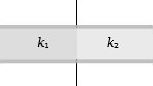
- 1A parallel plate capacitor with air as medium between the plates has a capacitance of $10\,\mu F$. The area of capacitor is divided into two equal halves and filled with two media as shown in the figure having dielectric constant ${k_1} = 2$and ${k_2} = 4$. The capacitance of the system will now be.......$\mu F$View Solution
- 2Two conducting spheres of radii $R_1$ and $R_2$ are charged with charges $Q_1$ and $Q_2$ respectively. On bringing them in contact there isView Solution
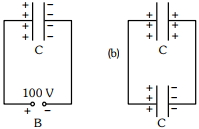
- 3A capacitor of capacitance $C =900\,pF$ is charged fully by $100\,V$ battery $B$ as shown in figure $(a)$. Then it is disconnected from the battery and connected to another uncharged capacitor of capacitance $C =900\,pF$ as shown in figure $(b)$. The electrostatic energy stored by the system $(b)$ is $\dots\dots\times 10^{-6}\,J$View Solution
- 4Identify the $WRONG$ statementView Solution
- 5Two equal point charges are fixed at $x = - a$ and $x = + a$ on the $x-$axis. Another point charge $Q$ is placed at the origin. The Change in the electrical potential energy of $Q$, when it is displaced by a small distance $x$ along the $x$-axis, is approximately proportional toView Solution
- 6Two condensers of capacities $2C$ and $C$ are joined in parallel and charged upto potential $V$. The battery is removed and the condenser of capacity $C$ is filled completely with a medium of dielectric constant $K$. The $p.d.$ across the capacitors will now beView Solution
- 7Two insulated charged conducting spheres of radii $20\,cm$ and $15\,cm$ respectively and having an equal charge of $10\,C$ are connected by a copper wire and then they are separated. ThenView Solution
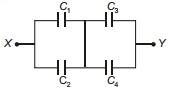
- 8In the circuit shown below $C_1=10 \,\mu F , C_2=C_3=20 \,\mu F$, and $C_4=40 \,\mu F$. If the charge on $C_1$ is $20 \,\mu C$ then potential difference between $X$ and $Y$ is ......... $V$View Solution
- 9Eight small drops, each of radius $r$ and having same charge $q$ are combined to form a big drop. The ratio between the potentials of the bigger drop and the smaller drop isView Solution
- 10View SolutionThe capacity of a parallel plate condenser depends on