In the circuit shown below $C_1=10 \,\mu F , C_2=C_3=20 \,\mu F$, and $C_4=40 \,\mu F$. If the charge on $C_1$ is $20 \,\mu C$ then potential difference between $X$ and $Y$ is ......... $V$
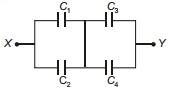
Medium
Download our app for free and get started
(b)
$q_3=20 \,\mu C$
$q_4=q_4=40 \,\mu C$
$\Delta V=\frac{20}{10}+\frac{20}{20}=3 \,V$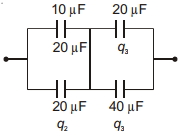

Download our appand get started for free
Experience the future of education. Simply download our apps or reach out to us for more information. Let's shape the future of learning together!No signup needed.*
Similar Questions
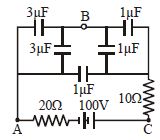
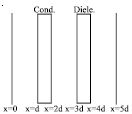
- 1The distance between plates of a parallel plate capacitor is $5d$. Let the positively charged plate is at $ x=0$ and negatively charged plate is at $x=5d$. Two slabs one of conductor and other of a dielectric of equal thickness $d$ are inserted between the plates as shown in figure. Potential versus distance graph will look like :View Solution
- 2Two charged particles of masses $m$ and $2m$ have charges $+2q$ and $+q$ respectively. They are kept in uniform electric field and allowed to move for some time. The ratio of their kinetic energies will beView Solution
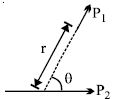
- 3View SolutionTwo short electric dipoles are placed as shown. The energy of electric interaction between these dipoles will be
- 4View SolutionPutting a dielectric substance between two plates of condenser, capacity, potential and potential energy respectively
- 5The area of the plates of a parallel plate capacitor is $A$ and the gap between them is $d$. The gap is filled with a non-homogeneous dielectric whose dielectric constant varies with the distance $‘y’$ from one plate as : $K = \lambda \ sec(\pi y/2d)$, where $\lambda $ is a dimensionless constant. The capacitance of this capacitor isView Solution
- 6The magnitude of electric field $E$ in the annular region of a charged cylindrical capacitorView Solution
- 7A conducting sphere of radius $R$ is given a charge $Q.$ The electric potential and the electric field at the centre of the sphere respectively areView Solution
- 8View SolutionA capacitor is charged by a battery. The battery is removed and another identical uncharged capacitor is connected in parallel. The total electrostatic energy of resulting system
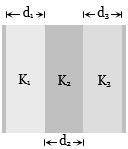
- 9The expression for the capacity of the capacitor formed by compound dielectric placed between the plates of a parallel plate capacitor as shown in figure, will be (area of plate $ = A$)View Solution
- 10In the figure below, what is the potential difference between the points $A$ and $B$ and between $B$ and $C$ respectively in steady stateView Solution