A $500\,\mu F$ capacitor is charged at a steady rate of $100\,\mu C/sec$ . The potential difference across the capacitor will be $10\,V$ after an interval of......$sec$
Medium
Download our app for free and get started
$\theta=\mathrm{CV}$
$\frac{\Delta \theta}{\Delta t}=C \frac{\Delta V}{\Delta t}$
$100 \times 10^{-6}=500 \times 10^{-6} \times \frac{10}{\Delta t}$
$\Delta \mathrm{t}=50 \mathrm{\,sec}$

Download our appand get started for free
Experience the future of education. Simply download our apps or reach out to us for more information. Let's shape the future of learning together!No signup needed.*
Similar Questions
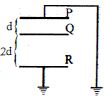
- 1See the diagram . Area of each plate is $2.0\ m^2$ and $d = 2 \times 10^{-3}\ m$. A charge of $8.85 \times 10^{-8}\ C$ is given to $Q$. Then the potential of $Q$ becomes......$V$View Solution
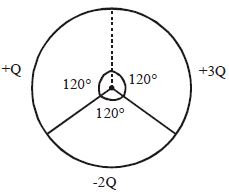
- 2Figure shows three circular arcs, each of radius $R$ and total charge as indicated. The net electric potential at the centre of curvature isView Solution
- 3Three capacitors of $2.0,\;3.0$ and $6.0\;\mu F$ are connected in series to a $10\,V$ source. The charge on the $3.0\,\mu F$ capacitor is........$\mu C$View Solution
- 4A spherical conductor of radius $2\,m$ is charged to a potential of $120\,V.$ It is now placed inside another hollow spherical conductor of radius $6\,m.$ Calculate the potential to which the bigger sphere would be raised......$V$View Solution
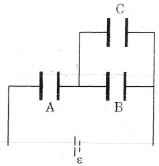
- 5Three capacitors $A,B$ and $C$ are connected with battery $emf\, \varepsilon $. All capacitors are identical initially. If dielectric slab is inserted between plates of capacitor $A$ slowy with help of external force thenView Solution
- 6A capacitor with plate separation $d$ is charged to $V$ volts. The battery is disconnected and a dielectric slab of thickness $\frac{d}{2}$ and dielectric constant ' $2$ ' is inserted between the plates. The potential difference across its terminals becomesView Solution
- 7A parallel plate capacitor is made of two circular plates separated by a distance $5\ mm$ and with a dielectric of dielectric constant $2.2$ between them. When the electric field in the dielectric is $3 \times 10^4$ $ Vm^{-1}$ the charge density of the positive plate will be close toView Solution
- 8Two large vertical and parallel metal plates having a separation of $1 \ cm$ are connected to a $DC$ voltage source of potential difference $X$. A proton is released at rest midway between the two plates. It is found to move at $45^{\circ}$ to the vertical $JUST$ after release. Then $X$ is nearlyView Solution
- 9A cathode ray tube contains a pair of parallel metal plates $1.0\, cm$ apart and $3.0\, cm$ long. A narrow horizontal beam of electron with a velocity $3 \times 10^7\, m/s$ passed down the tube midway between the plates. When a potential difference of $550\, V$ is maintained across the plates, it is found that the electron beam is so deflected that it just strikes the end of one of the plates. Then the specific charge of the electron in $C/kg$ isView Solution
- 10Electric potential at any point is $V = - 5x + 3y + \sqrt {15} z$, then the magnitude of the electric field isView Solution