Electric potential at any point is $V = - 5x + 3y + \sqrt {15} z$, then the magnitude of the electric field is
Medium
Download our app for free and get started
(d) ${E_x} = - \frac{{dV}}{{dx}} = - ( - 5) = 5;$${E_y} = - \frac{{dV}}{{dy}} = - 3$
and ${E_z} = - \frac{{dV}}{{dz}} = - \sqrt {15} $
${E_{net}} = \sqrt {E_x^2 + E_y^2 + E_z^2} = \sqrt {{{(5)}^2} + {{( - 3)}^2} + {{( - \sqrt {15} )}^2}} = 7$
and ${E_z} = - \frac{{dV}}{{dz}} = - \sqrt {15} $
${E_{net}} = \sqrt {E_x^2 + E_y^2 + E_z^2} = \sqrt {{{(5)}^2} + {{( - 3)}^2} + {{( - \sqrt {15} )}^2}} = 7$

Download our appand get started for free
Experience the future of education. Simply download our apps or reach out to us for more information. Let's shape the future of learning together!No signup needed.*
Similar Questions
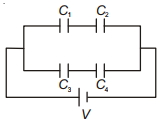
- 1Find the charge on capacitor $C_3$View Solution
Given, that $C_1=C_2=C$ and $C_3=C_4=3 C$.
- 2A thin metal plate $P$ is inserted half way between the plates of a parallel plate capacitor of capacitance $C$ in such a way that it is parallel to the two plates. The capacitance now becomesView Solution
- 3View SolutionState which of the following is correct
- 4If an electron moves from rest from a point at which potential is $50\, volt$ to another point at which potential is $70\, volt$, then its kinetic energy in the final state will beView Solution
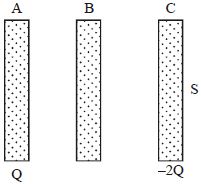
- 5Three identical metal plates with large surface areas are kept parallel to each other as shown in figure. The left most plates is given a charge $Q$ and the right most plate $C$ is given a charge $-2Q.$ The middle plate $B$ is neutral. Then the charge appearing on the outer surface $S$ of the plate $C$ is :-View Solution
- 6Two metal spheres $A$ and $B$ of radii $a$ and $b(a < b)$ respectively are at a large distance apart. Each sphere carries a charge of $100 \mu C$. The spheres are connected by a conducting wire, thenView Solution
- 7A cathode ray tube contains a pair of parallel metal plates $1.0\, cm$ apart and $3.0\, cm$ long. A narrow horizontal beam of electron with a velocity $3 \times 10^7\, m/s$ passed down the tube midway between the plates. When a potential difference of $550\, V$ is maintained across the plates, it is found that the electron beam is so deflected that it just strikes the end of one of the plates. Then the specific charge of the electron in $C/kg$ isView Solution
- 8Two capacitor having capacitances $8\ \mu F$ and $16\ \mu F$ have breaking voltages $20\ V$ and $80\ V$. They are combined in series. The maximum charge they can store individually in the combination is...... $\mu C$View Solution
- 9Two metallic plates form a parallel plate capacitor. The distance between the plates is $'d'.$ A metal sheet of thickness $\frac{d}{2}$ and of area equal to area of each plate is introduced between the plates. What will be the ratio of the new capacitance to the original capacitance of the capacitor $?$View Solution
- 10Potential atapoint $A$ is $3 $ $ volt$ and atapoint $B$ is $7$ $volt$,an electron is moving towards $A$ from $B.$View Solution