A $50\,\Omega $ resistance is connected to a battery of $5\,V$. A galvanometer of resistance $100\, \Omega $ is to be used as an ammeter to measure current through the resistance, for this a resistance $r_s$ is connected to the galvanometer. Which of the following connections should be employed if the measured current is within $1\% $ of the current without the ammeter in the circuit ?
JEE MAIN 2016, Diffcult


Download our appand get started for free
Experience the future of education. Simply download our apps or reach out to us for more information. Let's shape the future of learning together!No signup needed.*
Similar Questions
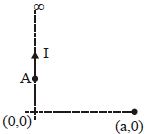
- 1An infinitely long wire carrying current $I$ is along $Y$ axis such that its one end is at point $A(0, b)$ while the wire extends upto $+ \infty .$ The magnitude of magnetic field strength at point $(a, 0)$View Solution
- 2Two identical moving coil galvanometer have $10 \Omega$ resistance and full scale deflection at $2 \mu A$ current. One of them is converted into a voltmeter of $100 mV$ full scale reading and the other into an Ammeter of $1 mA$ full scale current using appropriate resistors. These are then used to measure the voltage and current in the Ohm's law experiment with $R =1000 \Omega$ resistor by using an ideal cell. Which of the following statement( $s$ ) is/are correct?View Solution
$(1)$ The measured value of $R$ will be $978 \Omega$
$(2)$ The resistance of the Voltmeter will be $100 k \Omega$.
$(3)$ The resistance of the Ammeter will be $0.02 \Omega$ (round off to $2^{\text {nd }}$ decimal place)
$(4)$ If the ideal cell is replaced by a cell having internal resistance of $5 \Omega$ then the measured value of $R$ will be more than $1000 \Omega$.
- 3View SolutionMaximum kinetic energy of the positive ion in the cyclotron is
- 4A particle of mass $m,$ charge $Q$ and kinetic energy $K$ enters a transverse uniform magnetic field of induction $B.$ After $3$ $seconds$ the kinetic energy of the particle will be .......$K$View Solution
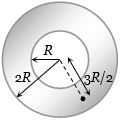
- 5Figure shows the cross-sectional view of the hollow cylindrical conductor with inner radius '$R$' and outer radius '$2R$', cylinder carrying uniformly distributed current along it's axis. The magnetic induction at point '$P$' at a distance $\frac{{3R}}{2}$ from the axis of the cylinder will beView Solution
- 6A moving coil galvanometer has resistance $50\,\Omega $ and it indicates full deflection at $4\,mA$ current. A voltmeter is made using this galvanometer and a $5\,k\Omega $ resistance. The maximum voltage, that can be measured using this voltamenter, will be close to ......$V$View Solution
- 7A beam of protons with speed $4 \times 10^{5}\, ms ^{-1}$ enters a uniform magnetic field of $0.3\, T$ at an angle of $60^{\circ}$ to the magnetic field. The pitch of the resulting helical path of protons is close to....$cm$View Solution
(Mass of the proton $=1.67 \times 10^{-27}\, kg$, charge of the proton $=1.69 \times 10^{-19}\,C$)
- 8A particle of mass $M$ and charge $Q$ moving with velocity $\mathop v\limits^ \to $ describes a circular path of radius $R$ when subjected to a uniform transverse magnetic field of induction $B$. The work done by the field when the particle completes one full circle isView Solution
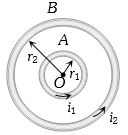
- 9$A$ and $B$ are two concentric circular conductors of centre $O$ and carrying currents ${i_1}$ and ${i_2}$ as shown in the adjacent figure. If ratio of their radii is $1 : 2$ and ratio of the flux densities at $O$ due to $A$ and $B$ is $1 : 3$, then the value of ${i_1}/{i_2}$ isView Solution
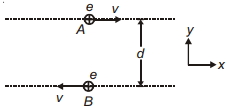
- 10Two protons $A$ and $B$ move parallel to the $x$-axis in opposite directions with equal speeds $v$. At the instant shown, the ratio of magnetic force and electric force acting on the proton $A$ is ( $c=$ speed of light in vacuum)View Solution