MCQ
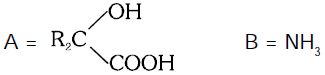
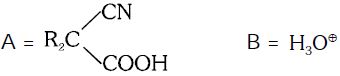
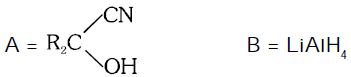
$A$ and $B$ in the following reaction are :-
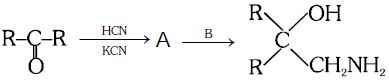
  • A

  • B

  • C


Answer

Correct option: D.

d

Need a full question paper?

Generate a complete, print-ready paper with questions like this in minutes — across 16+ boards, with answer keys.
Start Generating Free

Similar questions

Two point charges $( + Q)$ and $( - 2Q)$ are fixed on the $X-$axis at positions $a$ and $2a$ from origin respectively. At what positions on the axis, the resultant electric field is zero
A musician using an open flute of length $50\,cm$ produces second harmonic sound waves. A person runs towards the musician from another end of a hall at a speed of $10 \,km/h.$ If the wave speed is $330\,m/s,$ the frequency heard by the running person shall be close to...... $Hz$
A black body has maximum wavelength ${\lambda _m}$ at temperature $2000\; K$. Its corresponding wavelength at temperature $3000 \;K$ will be
A point charge of $10\,\mu C$ is placed at the origin. At what location on the $X$-axis should a point charge of $40\,\mu\,C$ be placed so that the net electric field is zero at $x =2\,cm$ on the $X$-axis ?
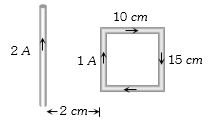
What is the net force on the square coil
A ball is thrown upwards at an angle of $60^o$ to the horizontal. It falls on the ground at a distance of $90 \,m$. If the ball is thrown with the same initial velocity at an angle $30^o$, it will fall on the ground at a distance of ........ $m$
A metal conductor of length $1\;m$ rotates vertically about one of its ends at angular velocity $5$ radians per second. If the horizontal component of earth's magnetic field is $0.2 \times {10^{ - 4}}\;T$, then the $e.m.f$. developed between the two ends of the conductor is
Column $- I$ gives certain physical terms associated with flow of current through a metallic conductor. Column $- II$ gives some mathematical relations involving electrical quantities. Match Column $- I$ and Column $- II$ with appropriate relations.
Column $- I$ Column $- II$
$(A)$ Drift Velocity $(P)$ $\frac{m}{n e^{2} \rho}$
$(B)$ Electrical Resistivity $(Q)$ $\mathrm{ne} v_{\mathrm{d}}$
$(C)$ Relaxation Period $(R)$ $\frac{\mathrm{eE}}{\mathrm{m}} \tau$
$(D)$ Current Density $(S)$ $\frac{E}{J}$
In a turbulent flow, the velocity of the liquid molecules in contact with the walls of the tube is
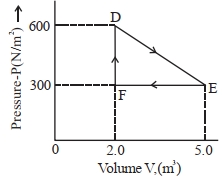
A thermodynamic system is taken from an original state $D$ to an intermediate state $E$ by the linear process shown in the figure. Its volume is then reduced to the original volume from $E$ to $F$ by an isobaric process. The total work done by the gas from $D$ to $E$ to $F$ will be $......J$