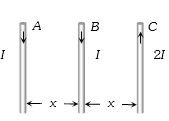
$A, B$ and $C$ are parallel conductors of equal length carrying currents $I, I$ and $2I$ respectively. Distance between $A$ and $B$ is $x$. Distance between $B$ and $C$ is also $x$. ${F_1}$ is the force exerted by $B$ on $A$ and $F_2$ is the force exerted by $B$ on $A$ choose the correct answer
Medium


Download our appand get started for free
Experience the future of education. Simply download our apps or reach out to us for more information. Let's shape the future of learning together!No signup needed.*
Similar Questions
- 1View SolutionThe phosphor bronze strip is used in a moving coil galvanometer because
- 2View SolutionThe ratio of the magnetic field at the cpentre of a current carrying circular wire and the magnetic field at the centre of a square coil made from the same length of wire will be
- 3Two long straight parallel conductors separated by a distance of $0.5\,m$ carry currents of $5\,A$ and $8\,A$ in the same direction. The force per unit length experienced by each other isView Solution
- 4A proton of mass $m$ and charge $+e$ is moving in a circular orbit in a magnetic field with energy $1\, MeV$. What should be the energy of $\alpha - $particle (mass = $4m$ and charge = $+ 2e),$ so that it can revolve in the path of same radius.......$MeV$View Solution
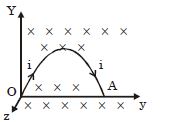
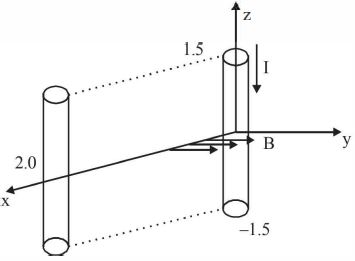
- 5A conductor lies along the $z-$axis $a$ $-1.5$$ \le Z < 1.5\,m$ carries a fixed current of $10.0\ A$ in $ - {\hat a_z}$ direction (see figure). For a field $\vec B$ $=$ $3.0 \times 10^{-4}$ $e^{-0.2x}$ ${\hat a_y}\,T$ find the power required to move the conductor at constant speed to $x = 2.0\ m, y = 0\ m$ in $5 \times 10^{-3}\ s$. Assume parallel motion along the $x-$axis........$ W$View Solution
- 6A galvanometer, whose resistance is $50\,ohm,$ has $25$ divisions in it. When a current of $4\times 10^{-4}\,A$ passes through it, its needle (pointer) deflects by one division. To use this galvanometer as a voltmeter of range $2.5\,V,$ it should be connected to a resistance of.......$ohm$View Solution
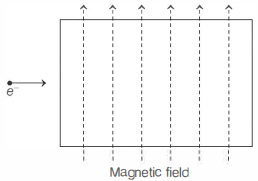
- 7View SolutionAn electron enters a chamber in which a uniform magnetic field is present as shown below. An electric field of appropriate magnitude is also applied, so that the electron travels undeviated without any change in its speed through the chamber. We are ignoring gravity. Then, the direction of the electric field is
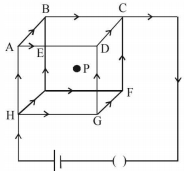
- 8A steady current is set up in a cubic network composed of wires of equal resistance and length $d$ as shown in figure. What is the magnetic field at the centre P due to the cubic networkView Solution
- 9A charged particle initially at rest at $O$,when released follows a trajectory as shown alongside. Such a trajectory is possible in the presence ofView Solution

- 10A wire carrying a current $I$ is placed inside a uniform magnetic field $\vec B=-B_0\hat k$. The shape of the wire is parabolic and has equation $Y = 2x -x^2.$ The force on the wire will be :View Solution