Question
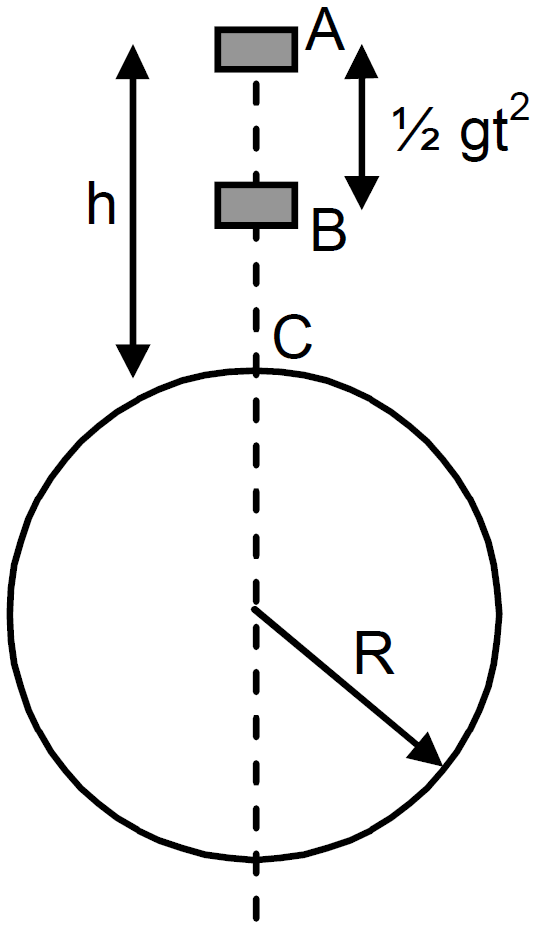
A ball is kept at a height h above the surface of a heavy transparent sphere made of a material of refractive index $\mu.$ The radius of the sphere is R. At t = 0, the ball is dropped to fall normally on the sphere. Find the speed of the image formed as a function of time for $\text{t}<\sqrt{\frac{2\text{h}}{\text{g}}}.$ Consider only the image by a single refraction.
Answer

Let us assume that it has taken time ‘t’ from A to B.$\therefore \ \text{AB}=\frac{1}{2}\text{gt}^2$
$\therefore \ \text{BC}= \text{h}-\frac{1}{2}\text{gt}^2$
This is the distance of the object from the lens at any time ‘t’. Here, $\text{u}=-\Big(\text{h}-\frac{1}{2}\text{gt}^2\Big)$$\mu_2=\mu$ (given) and $\mu_1=\text{i}$ (air)
So, $\Rightarrow\frac{\mu}{\text{v}}=\frac{1}{-\Big(\text{h}-\frac{1}{2}\text{gt}^2\Big)}=\frac{\mu-1}{\text{R}}$$\Rightarrow\frac{\mu}{\text{v}}=\frac{\mu-1}{\text{R}}=\frac{1}{\Big(\text{h}-\frac{1}{2}\text{gt}^2\Big)}=\frac{(\mu-1)\Big(\text{h}-\frac{1}{2}\text{gt}^2\Big)-\text{R}}{\text{R}\Big(\text{h}-\frac{1}{2}\text{gt}^2\Big)}$
So, v = image distance at any time ‘t $=\frac{\mu\text{R}\Big(\text{h}-\frac{1}{2}\text{gt}^2\Big)}{(\mu-1)\Big(\text{h}-\frac{1}{2}\text{gt}^2\Big)-\text{R}}$ So, velocity of the image $=\text{V}=\frac{\text{dv}}{\text{dt}}=\frac{\text{d}}{\text{dt}}\begin{bmatrix}\frac{\mu\text{R}\Big(\text{h}-\frac{1}{2}\text{gt}^2\Big)}{(\mu-1)\Big(\text{h}-\frac{1}{2}\text{gt}^2\Big)-\text{R}} \end{bmatrix}=\frac{\mu\text{R}^2\text{gt}}{(\mu-1)\Big(\text{h}-\frac{1}{2}\text{gt}^2\Big)-\text{R}}$ (can be found out).

Need a full question paper?

Generate a complete, print-ready paper with questions like this in minutes — across 16+ boards, with answer keys.

Start Generating Free

Similar questions

Define impulse and establish its relation with momentum change. Explain the importance of impulse. Or Define impulse of a force and prove that the impulse of a force on a body is equal to change in momentum. Or State the momentum impulse theorem. Explain its physical importance with examples.
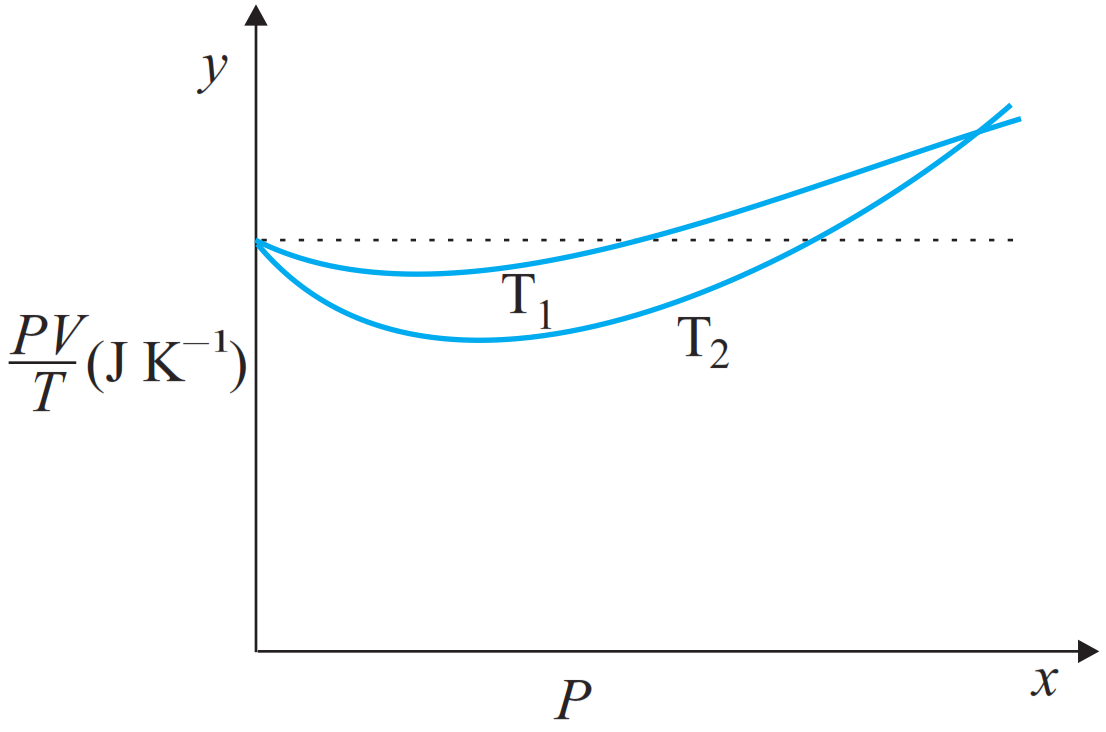
Shows plot of $\frac{\text{PV}}{\text{T}}$ versus P for $1.00 \times 10^{-3}kg$ of oxygen gas at two different temperatures: What is the value of $\frac{\text{PV}}{\text{T}}$ where the curves meet on the y-axis?
A small block of mass $200g$ is kept at the top of a frictionless incline which is $10m$ long and $3.2m$ high. How much work was required.
  1. To lift the block from the ground and put it at the top.
  2. To slide the block up the incline? What will be the speed of the block when it reaches the ground.
  3. It falls off the incline and drops vertically on the ground.
  4. It slides down the incline? Take $g = 10m/s^2$​​​​​​​.
A sonometer wire is vibrating in resonance with a tuning fork. Keeping the tension applied same, the length of the wire is doubled. Under what conditions would the tuning fork still be is resonance with the wire?
Prove that the path of one projectile as seen from another projectile is a straight line.
Point masses $m_1$ and $m_2$ are placed at the opposite ends of a rigid rod of length L, and negligible mass. The rod is to be set in rotation about an axis perpendicular to it. Find the position on this rod through which the axis should pass in order that the work required to set the rod in rotation with angular velocity $\omega_0$ should be minimum.
$3$ A man stands on a rotating platform, with his arms stretched horizontally holding a $5kg$ weight in each hand. The angular speed of the platform is $30$ revolutions per minute. The man then brings his arms close to his body with the distance of each weight from the axis changing from $90cm$ to $20cm$. The moment of inertia of the man together with the platform may be taken to be constant and equal to $7.6kgm^2$.
  1. What is his new angular speed? (Neglect friction).
  2. Is kinetic energy conserved in the process? If not, from where does the change come about?
A small block of mass $m$ slides along the frictionless loop$-$to$-$loop track shown in the Figure.
  1. If it starts from rest at $P$ what is the resultant force acting on it at $Q?$
  2. At what height above the bottom of loop should the block be released so that the force it exerts against the track at the top of the loop equals its weight?
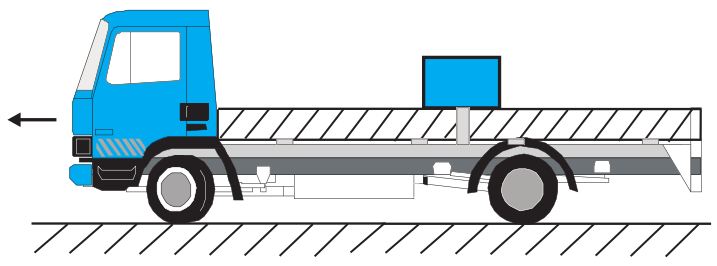
The rear side of a truck is open and a box of $40kg$ mass is placed 5m away from the open end as shown in Fig. The coefficient of friction between the box and the surface below it is $0.15$. On a straight road, the truck starts from rest and accelerates with $2ms^{-2}$. At what distance from the starting point does the box fall off the truck? (Ignore the size of the box).
Mean solar day is the time interval between two successive noon when sun passes through zenith point (meridian). Sidereal day is the time interval between two successive transit of a distant star through the zenith point (meridian). By drawing appropriate diagram showing earth’s spin and orbital motion, show that mean solar day is four minutes longer than the sidereal day. In other words, distant stars would rise 4 minutes early every successive day.