Point masses $m_1$ and $m_2$ are placed at the opposite ends of a rigid rod of length L, and negligible mass. The rod is to be set in rotation about an axis perpendicular to it. Find the position on this rod through which the axis should pass in order that the work required to set the rod in rotation with angular velocity $\omega_0$ should be minimum.
Download our app for free and get started
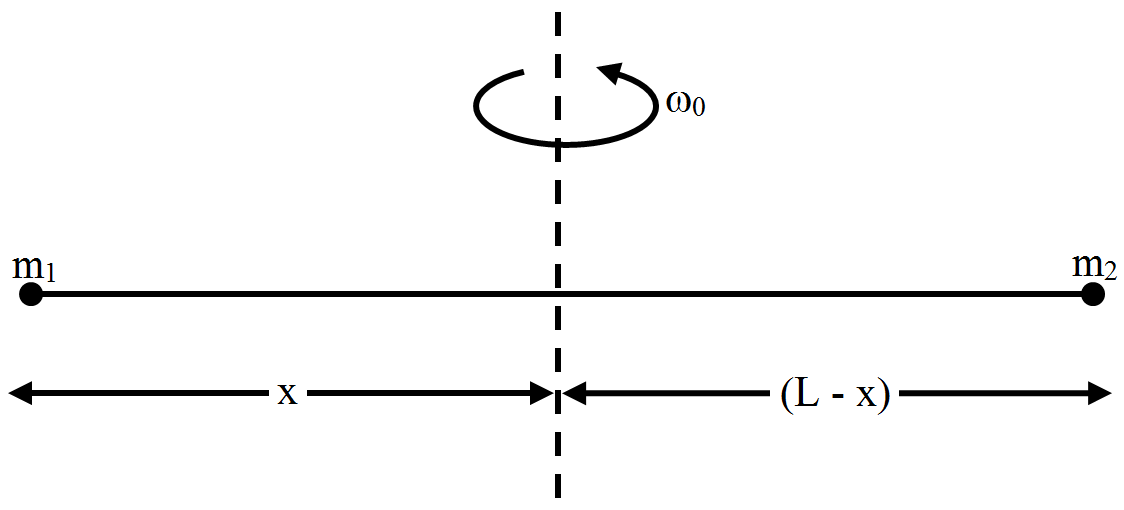
Let the axis of rotation be at a distance x from mass $m_1$. Therefore, the distance of the axis of rotation from mass $m_2$ is (L - x).
When the rod is set into rotation, the increase in the rotational K.E. is given by
$\text{K.E.}=\frac{1}{2}\text{I}_1\omega^2_0+\frac{1}{2}\text{I}_2\omega_0^2$
$=\frac{1}{2}\text{m}_1\text{x}^2\omega^2_0+\frac{1}{2}\text{m}_2(\text{L}-\text{x})^2\omega^2_0$
According to work energy theorem
Work done, SW= increase in rotational K.E.
$\text{i.e.,}\text{ W}=\frac{1}{2}\text{m}_1\text{x}^2\omega_0^2+\frac{1}{2}\text{m}_2(\text{L}-\text{x})^2\omega_0^2$
Work will be minimum if $\frac{\text{dW}}{\text{dx}}=0$
$\text{or }\frac{\text{d}}{\text{dx}}\Big[\frac{1}{2}\text{m}_1\text{x}^2\omega^2_0+\frac{1}{2}\text{m}_2(\text{L}-\text{x})^2\omega^2_0\Big]=0$
$\text{m}_1\text{x}\omega^2_0-\text{m}_2(\text{L}-\text{x})\omega^2_0=0$
$\omega^2_0[\text{m}_1\text{x}-\text{m}_2(\text{L}-\text{x})]=0$
Since $\omega^2_0\neq0$
$\therefore\text{m}_1\text{x}-\text{m}_2(\text{L}-\text{x})=0$
$\text{or }(\text{m}_1+\text{m}_2)\text{x}=\text{m}_2\text{L}$
$\therefore\text{x}=\frac{\text{m}_2\text{L}}{(\text{m}_1+\text{m}_2)}$

Download our appand get started for free
Experience the future of education. Simply download our apps or reach out to us for more information. Let's shape the future of learning together!No signup needed.*
Similar Questions
- 1Two cylindrical hollow drums of radii R and 2R, and of a common height h, are rotating with angular velocities $\omega$ (anti-clockwise) and $\omega$ (clockwise), respectively. Their axes, fixed are parallel and in a horizontal plane separated by $(3\text{R}+\delta).$ They are now brought in contact $(\delta\rightarrow0){:}$View Solution
- Show the frictional forces just after contact.
- Identify forces and torques external to the system just after contact.
- What would be the ratio of final angular velocities when friction ceases?
- 2View SolutionA wheel in uniform motion about an axis passing through its centre and perpendicular to its plane is considered to be in mechanical (translational plus rotational) equilibrium because no net external force or torque is required to sustain its motion. However, the particles that constitute the wheel do experience a centripetal acceleration directed towards the centre.How do you reconcile this fact with the wheel being in equilibrium? How would you set a half-wheel into uniform motion about an axis passing through the centre of mass of the wheel and perpendicular to its plane? Will you require external forces to sustain the motion?
- 3A meter stick held vertically, with one end on the ground, is then allowed to fall. What is the value of the radial and tangential acceleration of the top end of the stick when the stick has turned through on angle $\theta?$ What is the speed with which the top end of the stick hits the ground? Assume that the end of the stick in. contact with the ground does not slip.View Solution
- 43 A man stands on a rotating platform, with his arms stretched horizontally holding a 5kg weight in each hand. The angular speed of the platform is 30 revolutions per minute. The man then brings his arms close to his body with the distance of each weight from the axis changing from 90cm to 20cm. The moment of inertia of the man together with the platform may be taken to be constant and equal to $7.6kgm^2$.View Solution
- What is his new angular speed? (Neglect friction).
- Is kinetic energy conserved in the process? If not, from where does the change come about?
- 5View SolutionTwo particles, each of mass m and speed v, travel in opposite directions along parallel lines separated by a distance d. Show that the angular momentum vector of the two particle system is the same whatever be the point about which the angular momentum is taken.
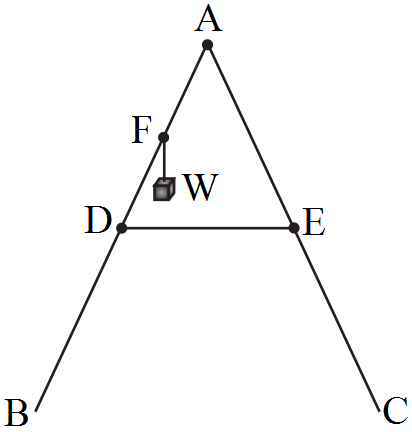
- 6As shown in the two sides of a step ladder BA and CA are $1.6m$ long and hinged at A. A rope DE, $0.5m$ is tied half way up. A weight $40kg$ is suspended from a point F, 1.2m from B along the ladder BA. Assuming the floor to be frictionless and neglecting the weight of the ladder, find the tension in the rope and forces exerted by the floor on the ladder. (Take $g = 9.8m/s^2$) (Hint: Consider the equilibrium of each side of the ladder separately).View Solution
- 7A cylinder of mass $5kg$ and radius $30cm$ and free to rotate about its axis, receives an angular impulse of $3kgm^2 s^{-1}$ followed by a similar impulse after every $4$ seconds. What is the angular speed of the cylinder $30s$ after the initial impulse? The cylinder is at rest initially.View Solution
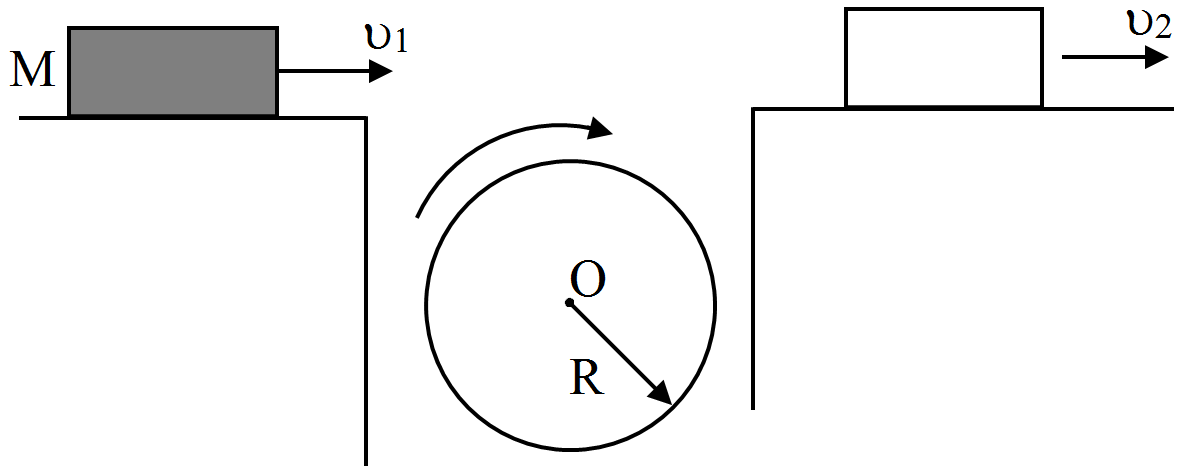
- 8A block of mass M is moving with a velocity $v_1$ on a frictionless surface as shown in fig. It passes over to a cylinder of radius R and moment of inertia I which has fixed axis and is initially at rest. When it first makes contact with the cylinder, it slips on the cylinder, but the friction is large enough so that slipping ceases before it losses contact with the cylinder. Finally it goes to the dotted position with velocity $v_2$ compute $v_2$ in terms of $v_1, M, I$ and $R$.View Solution
- 9Separation of Motion of a system of particles into motion of the centre of mass and motion about the centre of mass: Show $\text{L}=\text{L}'+\text{R}\times\text{MV}$ where $\text{L}'=\sum\text{r}'_\text{i}\times\text{p}'_\text{i}$ is the angular momentum of the system about the centre of mass with velocities taken relative to the centre of mass. Remember $\text{r}'_\text{i}=\text{r}_\text{i}-\text{R},$ rest of the notation is the standard notation used in the chapter.View Solution
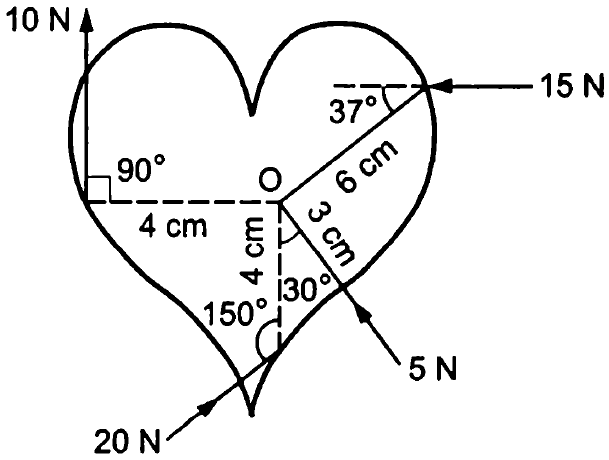
Note: $\text{L}'$ and $\text{MR}\times\text{V}$ can be said to be angular momenta, respectively, about and of the centre of mass of the system of particles. - 10View SolutionCalculate the total torque acting on the body shown in figure about the point O.