$3$ A man stands on a rotating platform, with his arms stretched horizontally holding a $5kg$ weight in each hand. The angular speed of the platform is $30$ revolutions per minute. The man then brings his arms close to his body with the distance of each weight from the axis changing from $90cm$ to $20cm$. The moment of inertia of the man together with the platform may be taken to be constant and equal to $7.6kgm^2$.
- What is his new angular speed? (Neglect friction).
- Is kinetic energy conserved in the process? If not, from where does the change come about?
Download our app for free and get started
- Moment of inertia of the man-platform system = $7.6kgm^2$
$2 \times mr^2$
$= 2 \times 5 \times (0.9)^2$
$= 8.1kgm^2$
Initial moment of inertia of the system, $I_i = 7.6 + 8.1 = 15.7kgm^2$
Angular speed, $\omega_{\text{i}}=300\text{rev/min}$
Angular momentum, $\text{L}_{\text{i}}=\text{I}_{\text{i}}\omega_{\text{i}}=15.7\times30\ ...(\text{i})$
Moment of inertia when the man folds his hands to a distance of 20cm,
$2 \times mr^2$
$= 2 \times 5 (0.2)^2 = 0.4kgm^2$
Final moment of inertia, $I_f = 7.6 + 0.4 = 8kgm^2$
Final angular speed $\omega_{\text{f}}$
Final angular momentum, $\text{L}_\text{f}=\text{I}_\text{f}\omega_\text{f}=0.798\omega_\text{f}\ ...(\text{ii})$
From the conservation of angular momentum, we have,
$\text{I}_{\text{i}}\omega_{\text{i}}=\text{I}_\text{f}\omega_\text{f}$
$\therefore\omega_\text{f}=15.7\times\frac{30}{8}=58.88\text{rev/min}$
- Kinetic energy is not conserved in the given process. In fact, with the decrease in the moment of inertia, kinetic energy increases. The additional kinetic energy comes from the work done by the man to fold his hands toward himself.

Download our appand get started for free
Experience the future of education. Simply download our apps or reach out to us for more information. Let's shape the future of learning together!No signup needed.*
Similar Questions
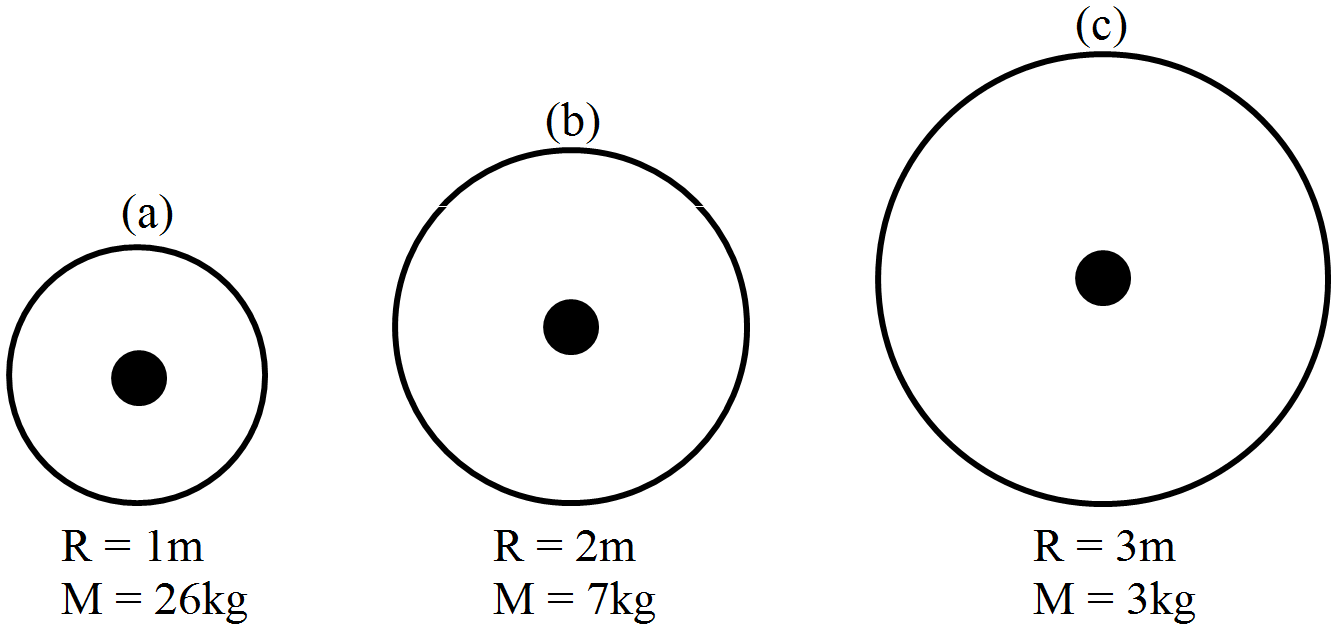
- 1View SolutionFigure shows three uniform discs, along with their radii R and masses M. Rank the discs according to their rotational inertia about their central axes, greatest first.
- 2A mass m is allowed to roll down an inclined plane $(\theta)$ If the vertical height is h, find.View Solution
- Acceleration along the inclined plane.
- Velocity down the plane.
- 3Calculate the angular momentum and rotational kinetic energy of earth about its own axis. How long could this amount of energy supply one kilowatt power to each of the $3.5 \times 10^9$ persons on earth? (Mass of earth = $6.0 \times 1024kg$ and radius = $6.4 \times 10^{24}km)$.View Solution
- 4View SolutionEstablish the relationship between Torque and Moment of Inertia.
- 5View SolutionA solid sphere rolls down two different inclined planes of the same heights but different angles of inclination.
- Will it reach the bottom with the same speed in each case?
- Will it take longer to roll down one plane than the other?
- If so, which one and why?
- 6A hollow sphere is released from the top of an inclined plane of inclination $\theta.$View Solution
- What should be the minimum coefficient of friction between the sphere and the plane to prevent sliding?
- Find the kinetic energy of the ball as it moves down a length 1 on the incline if the friction coefficient is half the value calculated in part (a).
- 7A uniform rod pivoted at its upper end hangs vertically. It is displaced through an angle of $60°$ and then released. Find the magnitude of the force acting on a particle of mass dm at the tip of the rod when the rod makes an angle of $37°$ with the vertical.View Solution
- 8View SolutionTwo particles, each of mass m and speed v, travel in opposite directions along parallel lines separated by a distance d. Show that the angular momentum vector of the two particle system is the same whatever be the point about which the angular momentum is taken.
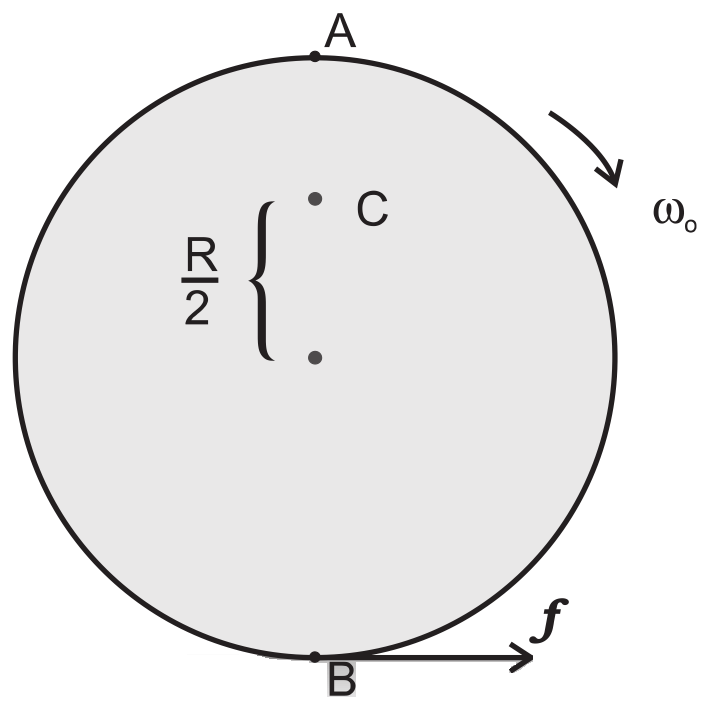
- 9A disc rotating about its axis with angular speed $\omega_0$ is placed lightly (without any translational push) on a perfectly frictionless table. The radius of the disc is R. What are the linear velocities of the points A, B and C on the disc shown in will the disc roll in the direction indicated?View Solution
- 10View SolutionA threaded rod with 12turns/ cm and diameter 1.18cm is mounted horizontally. A bar with a threaded hole to match the rod is screwed onto the rod. The bar spins at 216rev/ min. How long will it take for the bar to move 1.50cm along the rod?