A ball whose density is $0.4 × 10^3 kg/m^3$ falls into water from a height of $9 cm$ . To what depth does the ball sink........ $cm$
Diffcult
Download our app for free and get started
(b) The velocity of ball before entering the water surface
$v = \sqrt {2gh} = \sqrt {2g \times 9} $
When ball enters into water, due to upthrust of water the velocity of ball decreases (or retarded)
The retardation, a = $\frac{{{\rm{apparent weight}}}}{{{\rm{mass of ball}}}}$
$\frac{{ = V(\rho - \sigma )g}}{{V\rho }}$$ = \left( {\frac{{\rho - \sigma }}{\rho }} \right)g$$ = \left( {\frac{{0.4 - 1}}{{0.4}}} \right) \times g$$ = - \frac{3}{2}g$
If h be the depth upto which ball sink, then,
$0 - {v^2} = 2 \times \left( { - \frac{3}{2}g} \right) \times h$==> $2g \times 9 = 3gh$
$v = \sqrt {2gh} = \sqrt {2g \times 9} $
When ball enters into water, due to upthrust of water the velocity of ball decreases (or retarded)
The retardation, a = $\frac{{{\rm{apparent weight}}}}{{{\rm{mass of ball}}}}$
$\frac{{ = V(\rho - \sigma )g}}{{V\rho }}$$ = \left( {\frac{{\rho - \sigma }}{\rho }} \right)g$$ = \left( {\frac{{0.4 - 1}}{{0.4}}} \right) \times g$$ = - \frac{3}{2}g$
If h be the depth upto which ball sink, then,
$0 - {v^2} = 2 \times \left( { - \frac{3}{2}g} \right) \times h$==> $2g \times 9 = 3gh$
$h = 6 cm.$

Download our appand get started for free
Experience the future of education. Simply download our apps or reach out to us for more information. Let's shape the future of learning together!No signup needed.*
Similar Questions
- 1$Assertion : $ Machine parts are jammed in winter.View Solution
$Reason :$ The viscosity of lubricant used in machine parts increase at low temperatures. - 2Under a pressure head the rate of orderly volume flow of a liquid through a capillary tube is $Q$ . If the length of capillary tube is doubled and the diameter of tube is halved, the rate of flow would becomeView Solution
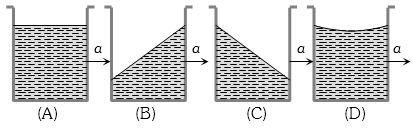
- 3View SolutionA vessel containing water is given a constant acceleration a towards the right, along a straight horizontal path. Which of the following diagram represents the surface of the liquid
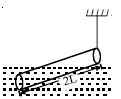
- 4A slender homogeneous rod of length $2L$ floats partly immersed in water, being supported by a string fastened to one of its ends, as shown. The specific gravity of the rod is $0.75$. The length of rod that extends out of water is :View Solution
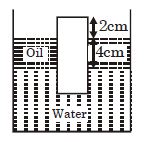
- 5A cylinder of radius $4\ cm$ and height $10\ cm$ is immersed in two liquids as shown. Specific gravity of oil is $0.5$ . $2\ cm$ of cylinder is in the air. Select the $INCORRECT$ statement. Neglect atmospheric pressure.View Solution
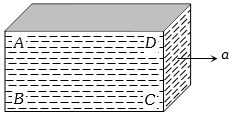
- 6A closed rectangular tank is completely filled with water and is accelerated horizontally with an acceleration a towards right. Pressure is $(i)$ maximum at, and $ (ii) $ minimum atView Solution
- 7Three liquids of equal masses are taken in three identical cubical vessels $A, B$ and $C .$ Their densities are $\rho_{A}, \rho_{B}$ and $\rho_{C} \cdot$ The force exerted by the liquid on the base of the cubical vessel isView Solution
- 8Two bodies having volumes $V$ and $2V $ are suspended from the two arms of a common balance and they are found to balance each other. If larger body is immersed in oil (density $d_1 $ $=$ $ 0.9$ $ gm/cm^3$) and the smaller body is immersed in an unknown liquid, then the balance remain in equilibrium. The density of unknown liquid is given by ......... $gm/cm^3$View Solution
- 9View SolutionBernoulli’s principle is based on the law of conservation of
- 10The bulk modulus of a liquid is $3 \times 10^{10}\, Nm ^{-2}$. The pressure required to reduce the volume of liquid by $2 \%$ is ........ $\times 10^{8}\; Nm ^{-2}$View Solution