$Assertion : $ Machine parts are jammed in winter.
$Reason :$ The viscosity of lubricant used in machine parts increase at low temperatures.
$Reason :$ The viscosity of lubricant used in machine parts increase at low temperatures.
AIIMS 2007, Easy


Download our appand get started for free
Experience the future of education. Simply download our apps or reach out to us for more information. Let's shape the future of learning together!No signup needed.*
Similar Questions
- 1Water from a pipe is coming at a rate of $100\, litres$ per minute. If the radius of the pipe is $5\, cm$, the Reynolds number for the flow is of the order of : (density of water $= 1000\, kg/m^3$, coefficient of viscosity of water $= 1\, mPa\, s$)View Solution
- 2An aeroplane of mass $3 \times 10^4\,kg$ and total wing area of $120\,m^2$ is in a level flight at some height. The difference in pressure between the upper and lower surfaces of its wings in kilopascals is........... $kPa$ $(g=10\,m/s^2)$View Solution
- 3View SolutionThe lift of an air plane is based on
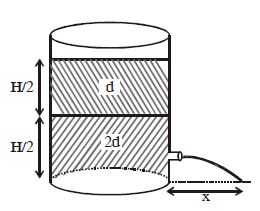
- 4A container of large uniform cross-sectional area $A$ is resting on a horizontal surface holds two immiscible, non-viscous and incompressible liquids of densities $d$ and $2d$ each of height $\frac{H}{2}$ as shown. The lower density of liquid is open to atmosphere. A small hole is made on the wall of container at height $h\left( {h < \frac{H}{2}} \right)$. The initial speed of efflux of the liquid at the hole isView Solution
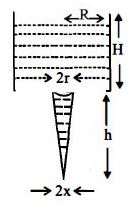
- 5Consider a water jar of radius $R$ that has water filled up to height $H$ and is kept on a stand of height $h$ (see figure) . Through a hole of radius $r$ $(r << R)$ at its bottom, the water leaks out and the stream of water coming down towards the ground has a shape like a funnel as shown in the figure. If the radius of the cross-section of water stream when it hits the ground is $x.$ ThenView Solution
- 6View SolutionA liquid disturbed by stirring comes to rest after some time due to its property of
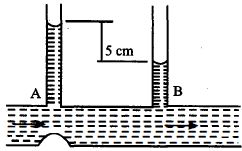
- 7In the diagram shown, the difference in the two tubes of the manometer is $5\, \ cm$, the cross section of the tube at $A$ and $B$ is $6\, mm^2$ and $10\, mm^2$ respectively. The rate at which water flows through the tube is $........ cc/s$View Solution
$(g\, = 10\, ms^{-2})$
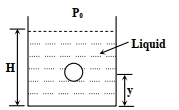
- 8A small spherical monoatomic ideal gas bubble $\left(\gamma=\frac{5}{3}\right)$ is trapped inside a liquid of density $\rho_{\ell}$ (see figure). Assume that the bubble does not exchange any heat with the liquid. The bubble contains n moles of gas. The temperature of the gas when the bubble is at the bottom is $\mathrm{T}_0$, the height of the liquid is $\mathrm{H}$ and the atmospheric pressure is $\mathrm{P}_0$ (Neglect surface tension).View Solution
Figure: $Image$
$1.$ As the bubble moves upwards, besides the buoyancy force the following forces are acting on it
$(A)$ Only the force of gravity
$(B)$ The force due to gravity and the force due to the pressure of the liquid
$(C)$ The force due to gravity, the force due to the pressure of the liquid and the force due to viscosity of the liquid
$(D)$ The force due to gravity and the force due to viscosity of the liquid
$2.$ When the gas bubble is at a height $\mathrm{y}$ from the bottom, its temperature is
$(A)$ $\mathrm{T}_0\left(\frac{\mathrm{P}_0+\rho_0 \mathrm{gH}}{\mathrm{P}_0+\rho_t \mathrm{gy}}\right)^{2 / 5}$
$(B)$ $T_0\left(\frac{P_0+\rho_t g(H-y)}{P_0+\rho_t g H}\right)^{2 / 5}$
$(C)$ $\mathrm{T}_0\left(\frac{\mathrm{P}_0+\rho_t \mathrm{gH}}{\mathrm{P}_0+\rho_t \mathrm{gy}}\right)^{3 / 5}$
$(D)$ $T_0\left(\frac{P_0+\rho_t g(H-y)}{P_0+\rho_t g H}\right)^{3 / 5}$
$3.$ The buoyancy force acting on the gas bubble is (Assume $R$ is the universal gas constant)
$(A)$ $\rho_t \mathrm{nRgT}_0 \frac{\left(\mathrm{P}_0+\rho_t \mathrm{gH}\right)^{2 / 5}}{\left(\mathrm{P}_0+\rho_t \mathrm{gy}\right)^{7 / 5}}$
$(B)$ $\frac{\rho_{\ell} \mathrm{nRgT}_0}{\left(\mathrm{P}_0+\rho_{\ell} \mathrm{gH}\right)^{2 / 5}\left[\mathrm{P}_0+\rho_{\ell} \mathrm{g}(\mathrm{H}-\mathrm{y})\right]^{3 / 5}}$
$(C)$ $\rho_t \mathrm{nRgT} \frac{\left(\mathrm{P}_0+\rho_t g \mathrm{H}\right)^{3 / 5}}{\left(\mathrm{P}_0+\rho_t g \mathrm{~g}\right)^{8 / 5}}$
$(D)$ $\frac{\rho_{\ell} \mathrm{nRgT}_0}{\left(\mathrm{P}_0+\rho_{\ell} \mathrm{gH}\right)^{3 / 5}\left[\mathrm{P}_0+\rho_t \mathrm{~g}(\mathrm{H}-\mathrm{y})\right]^{2 / 5}}$
Give the answer question $1,2,$ and $3.$
- 9A tank is filled up to a height $2H$ with a liquid and is placedon a platform of height $H$ from the ground. The distance $x$ from the ground where a small hole is punched to get the maximum range $R$ is:View Solution
- 10In an experiment, a small steel ball falls through a Iiquid at a constant speed of $10\, cm/s$. If the steel ball is pulled upward with a force equal to twice its effective weight, how fast will it move upward ? ......... $cm/s$View Solution