Under a pressure head the rate of orderly volume flow of a liquid through a capillary tube is $Q$ . If the length of capillary tube is doubled and the diameter of tube is halved, the rate of flow would become
Medium
Download our app for free and get started
$\mathrm{Q}=\frac{\pi \mathrm{Pr}^{4}}{8 \mathrm{n} \ell}$
$\frac{Q^{\prime}}{Q}=\left(\frac{r_{2}}{r_{1}}\right)^{4}\left(\frac{\ell_{1}}{\ell_{2}}\right)$
$Q^{\prime}=\left(\frac{1}{2}\right)^{4}\left(\frac{1}{2}\right)^{4} Q=\frac{Q}{32}$

Download our appand get started for free
Experience the future of education. Simply download our apps or reach out to us for more information. Let's shape the future of learning together!No signup needed.*
Similar Questions
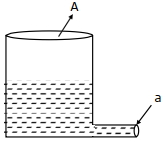
- 1A light cylindrical vessel is kept on a horizontal surface. Area of base is A. A hole of crosssectional area $'a'$ is made just at its bottom side. The minimum coefficient of friction necessary to prevent sliding the vessel due to the impact force of the emerging liquid is $(a\,<\,<\,A)$View Solution
- 2In an experiment, a small steel ball falls through a Iiquid at a constant speed of $10\, cm/s$. If the steel ball is pulled upward with a force equal to twice its effective weight, how fast will it move upward ? ......... $cm/s$View Solution
- 3A liquid is kept in a cylindrical vessel which is being rotated about a vertical axis through the centre of the circular base. If the radius of the vessel is $ r $ and angular velocity of rotation is $\omega $, then the difference in the heights of the liquid at the centre of the vessel and the edge isView Solution
- 4Spherical balls of radius $ 'r'$ are falling in a viscous fluid of viscosity '$\eta$' with a velocity $ 'v'. $ The retarding viscous force acting on the spherical ball isView Solution
- 5Consider the wall of a dam to be straight with height $H$ and length $L$. It holds a lake of water of height $h (h < H)$ on one side. Let the density of water be $\rho_{ w }$. Denote the torque about the axis along the bottom length of the wall by $\tau_1$. Denote also a similar torque due to the water up to height $h / 2$ and wall length $L / 2$ by $\tau_2$. Then $\tau_1 / \tau_2$ (ignore atmospheric pressure) isView Solution
- 6A air bubble of radius $1\,cm$ in water has an upward acceleration $9.8\, cm\, s ^{-2}$. The density of water is $1\, gm\, cm ^{-3}$ and water offers negligible drag force on the bubble. The mass of the bubble is$.......gm$View Solution
$\left( g =980 \,cm / s ^{2}\right)$
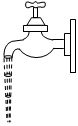
- 7View SolutionWater coming out of the mouth of a tap and falling vertically in streamline flow forms a tapering column, i.e., the area of cross-section of the liquid column decreases as it moves down. Which of the following is the most accurate explanation for this
- 8View SolutionThe displacement of a ball falling from rest in a viscous medium is platted against time. Choose a possible option
- 9A ball rises to surface at a constant velocity in a liquid whose density is $4$ times greater than that of the material of the ball. The ratio of the force of friction acting on the rising ball and its weight isView Solution
- 10A fluid is flowing through a horizontal pipe of varying cross-section, with speed $v\;ms^{-1}$ at a point where the pressure is $P$ Pascal. At another point where pressure is $\frac{ P }{2}$ Pascal its speed is $V\;ms^{-1}$. If the density of the fluid is $\rho\, kg\, m ^{-3}$ and the flow is streamline, then $V$ is equal toView Solution