A ball whose density is $0.4 \times 10^3\,kg/m^3$ falls into water from a height of $9\,cm$ . To what depth does the ball sink ? ....... $cm$
Diffcult


Download our appand get started for free
Experience the future of education. Simply download our apps or reach out to us for more information. Let's shape the future of learning together!No signup needed.*
Similar Questions
- 1For the situation shown in the figure, water flows on the surface of a fixed plate. TheView Solution
velocity of water as a function of distance $'y'$ is given as : $u = \alpha \left[ {\frac{y}{h} - 2{{\left( {\frac{y}{h}} \right)}^2}} \right]$ . Determine the magnitude of the shear stress that the water applies at the base of the plate. Coefficient of viscosity is $\eta$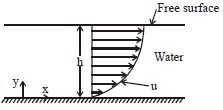
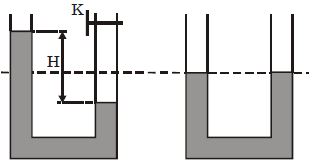
- 2A $U$ -tube of small and uniform cross section contains water of total length $4H$. The height difference between the water columns on the left and on the right is $H$ when the valve $K$ is closed. The valve is suddenly open, and water is flowing from left to right. Ignore friction. The speed of water when the heights of the left and the right water columns are the same, is :-View Solution
- 3In an experiment, a small steel ball falls through a Iiquid at a constant speed of $10\, cm/s$. If the steel ball is pulled upward with a force equal to twice its effective weight, how fast will it move upward ? ......... $cm/s$View Solution
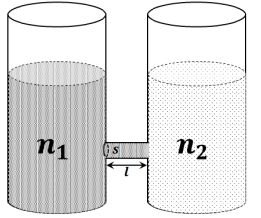
- 4As shown schematically in the figure, two vessels contain water solutions (at temperature $T$ ) of potassium permanganate $\left( KMnO _4\right)$ of different concentrations $n_1$ and $n_2\left(n_1>n_2\right)$ molecules per unit volume with $\Delta n=\left(n_1-n_2\right) \ll n_1$. When they are connected by a tube of small length $\ell$ and cross-sectional area $S , KMnO _4$ starts to diffuse from the left to the right vessel through the tube. Consider the collection of molecules to behave as dilute ideal gases and the difference in their partial pressure in the two vessels causing the diffusion. The speed $v$ of the molecules is limited by the viscous force $-\beta v$ on each molecule, where $\beta$ is a constant. Neglecting all terms of the order $(\Delta n)^2$, which of the following is/are correct? ( $k_B$ is the Boltzmann constant)-View Solution
$(A)$ the force causing the molecules to move across the tube is $\Delta n k_B T S$
$(B)$ force balance implies $n_1 \beta v \ell=\Delta n k_B T$
$(C)$ total number of molecules going across the tube per sec is $\left(\frac{\Delta n}{\ell}\right)\left(\frac{k_B T}{\beta}\right) S$
$(D)$ rate of molecules getting transferred through the tube does not change with time
- 5Pressure at the bottom of a tank of water is $3P$, where $P$ is atmospheric pressure. If water is drawn out till the level of water is lowered by one fifth, then the pressure at the bottom of the tank isView Solution
- 6The value of $g $ at a place decreases by $ 2\%.$ The barometric height of mercuryView Solution
- 7Water flows in a horizontal tube (see figure). The pressure of water changes by $700\; \mathrm{Nm}^{-2}$ between $\mathrm{A}$ and $\mathrm{B}$ where the area of cross section are $40\; \mathrm{cm}^{2}$ and $20\; \mathrm{cm}^{2},$ respectively. Find the rate of flow of water through the tube. ........ $\mathrm{cm}^{3} / \mathrm{s}$View Solution
(density of water $=1000\; \mathrm{kgm}^{-3}$ )

- 8A small hole of area of cross-section $2\; \mathrm{mm}^{2}$ is present near the bottom of a fully filled open tank of height $2\; \mathrm{m} .$ Taking $\mathrm{g}=10 \;\mathrm{m} / \mathrm{s}^{2},$ the rate of flow of water through the open hole would be nearly ......... $\times 10^{-6} \;m^{3} /s$View Solution
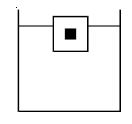
- 9View SolutionThere is a metal cube inside a block of ice which is floating on the surface of water. The ice melts completely and metal falls in the water. Water level in the container
- 10A lead shot of $1mm$ diameter falls through a long column of glycerine. The variation of its velocity $v$. with distance covered is represented byView Solution