Question
A balloon with hydrogen in it rises up but a balloon with air comes down, Why?

Answer

The density of hydrogen is less than air. So, the buoyant force on the balloon will be more than its weight in case of the hydrogen. So, in this case the balloon rises up. In case of air, the weight of balloon is more than the buoyant force acting on it, so balloon will come down.

Need a full question paper?

Generate a complete, print-ready paper with questions like this in minutes — across 16+ boards, with answer keys.
Start Generating Free

Similar questions

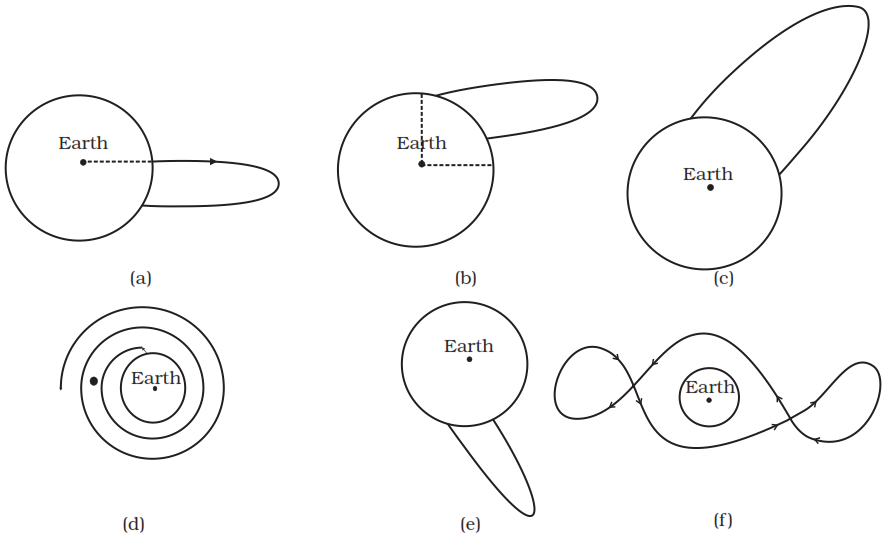
Shown are several curves. Explain with reason, which ones amongst them can be possible trajectories traced by a projectile (neglect air friction).
What are the limitations of the first law of thermodynamics?
Define triple point of water. Why is it unique?
Show that in elastic one dimensional collision, velocity of approach before collision is equal to velocity of separation after collision.
A spring whose force constant is $k$ obeys Hooke's is law 4 J of work is required by pulling it to a length of 10 cm from the original length. Calculate :(i) Value of k
(ii) Additional work required to stretch the spring by additional 10 cm length.
Does a body at 20°C radiate in a room, where the room temperature is 30°C? If yes, why does its temperature not fall further?
A human is moving on a plane surface with a box in his hand whose mass is 2 kg . If he walks with an acceleration of $0.5 m / s ^2$ to distance 40 m then what will be the work done by the man on the box during the motion?
The apparent weight of an object increases in an elevator while accelerating upward. A moongphaliwala sells his moongphali using a beam balance in an elevator. Will he gain more if the elevator is accelerating up?
If we put a cardboard (say 20cm × 20cm) between a light source and our eyes, we can't see the light. But when we put the same cardboard between a sound source and our ear, we hear the sound almost clearly. Explain.
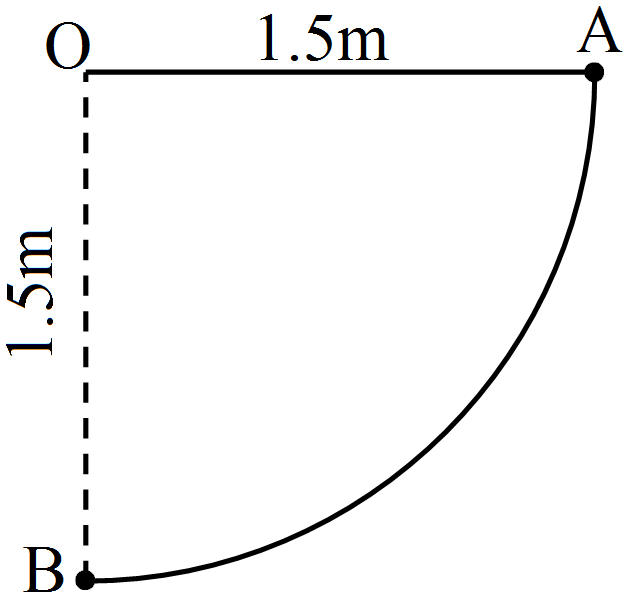
The bob of a pendulum is released from a horizontal A as shown. If the length of the pendulum is $1.5m$, what is the speed with which the bob arrives at the lowermost point B, given that it dissipates 5% of its initial energy against air resistance?