Question
A bar magnet takes $\frac{\pi}{10}$ second to complete one oscillation in an oscillation magnetometer. The moment of inertia of the magnet about the axis of rotation is $1.2 \times 10^{-4} \ kg-m^2$ and the earth's horizontal magnetic field is $30\mu \text{T}.$ Find the magnetic moment of the magnet.
Answer

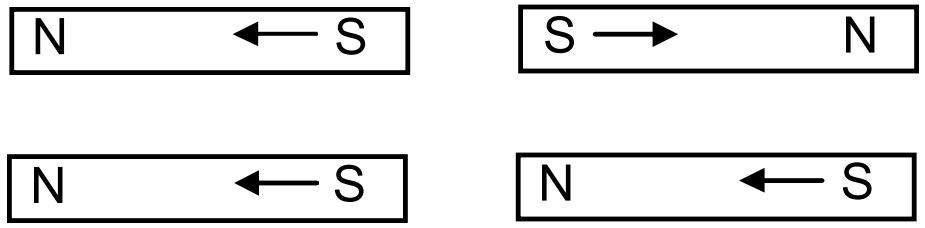
We know: $\text{v}=\frac{1}{2\pi}\sqrt{\frac}{\text{mB}_\text{H}}{\text{I}}$For like poles tied together
$M = M_1 - M_2$_
For unlike poles $M' = M_1+ M_2$​​​​​​​​​​​​​​
$\frac{\text{v}_1}{\text{v}_2}=\sqrt{\frac{\text{M}_1-\text{M}_2}{\text{M} _1-\text{M}_2}}\Rightarrow\Big(\frac{10}{2}\Big)^2$
$=\frac{\text{M}_1-\text{M}_2}{\text{M}_1+\text{M}_2}\Rightarrow25=\frac{\text{M}_1-\text{M}_2}{\text{M}_1+\text{M}_2}$
$\Rightarrow\frac{26}{24}=\frac{2\text{M}_1}{2\text{M}_2}\Rightarrow\frac{\text{M}_1}{\text{M}_2}=\frac{13}{12}$

Need a full question paper?

Generate a complete, print-ready paper with questions like this in minutes — across 16+ boards, with answer keys.

Start Generating Free

Similar questions

Cloudy nights are warmer than the nights with clean sky. Explain.

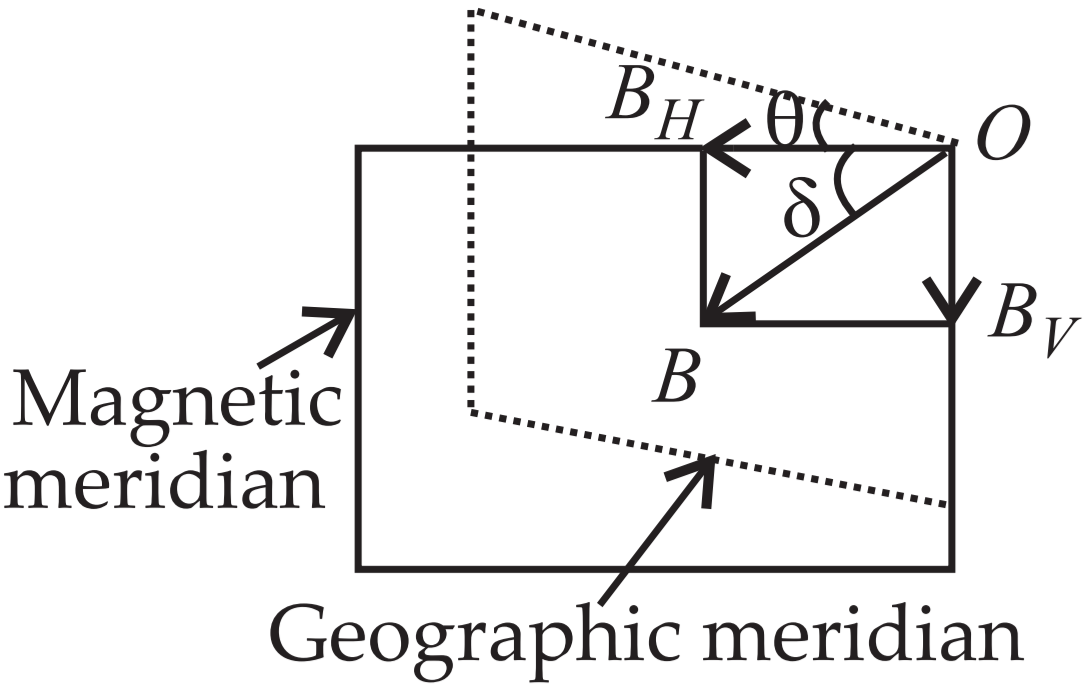
'Tile earth's magnetic field at a point on its surface is usually characterised by three quantities: (a) declination (bl inclination or dip and (cl horizontal component of the field. These are known as the elements of the earth's magnetic field. At a place, angle between geographic meridian and magnetic meridian is defined as magnetic declination, whereas angle made by the earth's magnetic field with the horizontal in magnetic meridian is known as magnetic dip.
  1. In a certain place, the horizontal component of magnetic field is $\frac{1}{\sqrt{3}}$ times the vertical component. 'Tile angle of dip at this place is:
  1. $\text{Zero}$
  2. $\frac{\pi}{3}$
  3. $\frac{\pi}{2}$
  4. $\frac{\pi}{6}$
  1. The angle between the true geographic north and the north shown by a compass needle is called as:
  1. Inclination.
  2. Magnetic declination.
  3. Angle of meridian.
  4. Magnetic pole.
  1. Tile angles of dip at the poles and the equator respectively are
  1. 30º, 30º
  2. 0º, 90º
  3. 45º, 90º
  4. 90º, 0º 
  1. A compass needle which is allowed to move in a horizontal plane is taken to a geomagnetic pole. It
  1. Will become rigid showing no movement.
  2. Will stay in any position.
  3. Will stay in north-south direction only.
  4. Will stay in east-west direction only. 
  1. Select the correct statement from the following.
  1. The magnetic dip is zero at the centre of the earth.
  2. Magnetic dip decreases as we move away from the equator towards the magnetic pole.
  3. Magnetic dip increases as we move away from the equator towards the magnetic pole.
  4. Magnetic dip does not vary from place to place. 
 A magnetic field can be produced by moving, charges or electric currents. The basic equation governing the magnetic field due to a current distribution is the Biot-Savart law. Finding the magnetic field resulting from a current distribution involves the vector product, and is inherently a calculas problem when the distance from the current to the field point is continuously changing. According to this law, the magnetic field at a point due to a current element of length $\text{d}\vec{\text{I}}$ carrying current I, at a distance r from the element is $\text{dB}=\frac{\mu_0}{4\pi}\frac{\text{I}(\text{d}{\vec{\text{I}}\times\vec{\text{r}}})}{\text{r}^3}$Biot-Savart law has certain similarities as well as difference with Coloumb's law for electrostatic field e.g., there is an angle dependence in Biot-Savart law which is not present in electrostatic case.
  1. The direction of magnetic field $\text{d}\vec{\text{B}}$ due to a current element $\text{Id}\vec{\text{l}}$ at a point of distance $\vec{\text{r}}$ from it, when a current I passes through a long conductor is in the direction
  1. Of position vector $\vec{\text{r}}$ of the point.
  2. Of current element $\text{Id}\vec{\text{l}}$
  3. Perpendicular to both $\text{d}\vec{\text{l}}$ and $\vec{\text{r}}$
  4. Perpendicular to $\text{d}\vec{\text{l}}$ only.
  1. The magnetic field due to a current in a straight wire segment of length Lat a point on its perpendicular bisector at a distance r (r >> L)
  1. Decreases as $\frac{1}{\text{r}}$
  2. Decreases as $\frac{1}{\text{r}^2}$
  3. Decreases as $\frac{1}{\text{r}^3}$
  4. approaches a finite limit as $\text{r}\rightarrow\infty$
  1. Two long straight wires are set parallel to each other. Each carries a current i in the same direction and the separation between them is 2r. The intensity of the magnetic field midway between them is:
  1. $\mu_0\frac{\text{i}}{\text{r}}$
  2. $4\mu_0\frac{\text{i}}{\text{r}}$
  3. $\text{Zero}$
  4. $\mu_0\frac{\text{i}}{\text{4r}}$
  1. A long straight wire carries a current along the z-axis for any two points in the x - y plane. Which of the following is always false?
  1. The magnetic fields are equal.
  2. The directions of the magnetic fields are the same.
  3. The magnitudes of the magnetic fields are equal.
  4. The field at one point is opposite to that at the other point.
  1. Biot-Savart law can be expressed alternatively as:
  1. Coulomb's Law.
  2. Ampere's circuital law.
  3. Ohm's Law.
  4. Gauss's Law. 
Why is it found experimentally difficult to detect neutrinos in nuclear $\beta$-decay?
The saturation current from a thoriated$-$tungsten cathode at $2000K$ is $100mA.$ What will be the saturation current for a pure$-$tungsten cathode of the same surface area operating at the same temperature? The constant $A$ in the Richardson$-$Dushman equation is $60 \times 10^4Am^{-2}K^{-2}$ for pure tungsten and $3.0 \times 10^4Am^{-2}k^{-2}$ for thoriated tungsten. The work function of pure tungsten is $4.5eV$ and that of thoriated tungsten is $2.6eV.$
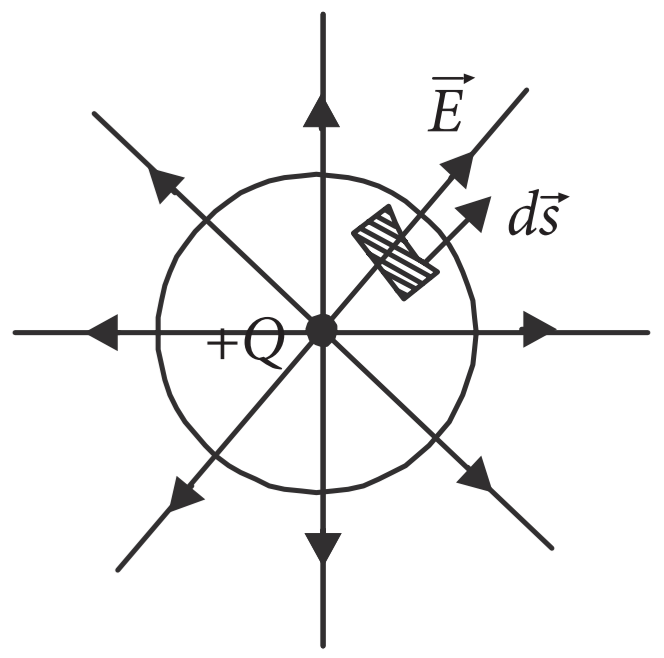
Gauss's law and Coulomb's law, although expressed in different forms, are equivalent ways of describing the relation between charge and electric field in static conditions. Gauss's law is $\epsilon_0\phi=\text{q}_{\text{end},}$ when $\text{q}_{\text{encl}}$ is the net charge inside an imaginary closed surface called Gaussian surface. $\phi=\oint\vec{\text{E}}\cdot\text{d}\vec{\text{A}}$ gives the electric flux through the Gaussian surface. The two equations hold only when the net charge is in vacuum or air.
  1. If there is only one type of charge in the universe, then $(\vec{\text{E}}\rightarrow$ Electric field, $\text{d}\vec{\text{s}}\rightarrow$ Area vector$)$.
  1. $\oint\vec{\text{E}}\cdot\text{d}\vec{\text{s}}\not=0$ on any surface.
  2. $\oint\vec{\text{E}}\cdot\text{d}\vec{\text{s}}$ could not be defined.
  3. $\oint\vec{\text{E}}\cdot\text{d}\vec{\text{s}}=\infty$ if charge is inside.
  4. $\oint\vec{\text{E}}\cdot\text{d}\vec{\text{s}}=0$ if charge is outside, $\oint\vec{\text{E}}\cdot\text{d}\vec{\text{s}}=\frac{\text{q}}{\epsilon_0}$ if charge is inside.
  1. What is the nature of Gaussian surface involved in Gauss law of electrostatic?
  1. Magnetic.
  2. Scalar.
  3. Vector.
  4. Electrical.
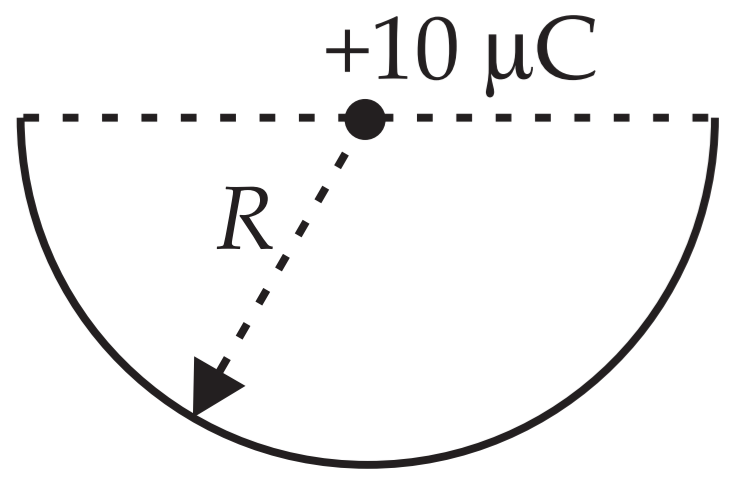
  1. A charge $10\mu\text{C}$ is placed at the centre of a hemisphere of radius $R = 10\ cm$ as shown. The electric flux through the hemisphere $($in $\text{MKS}$ units$)$ is:
  1. $20 \times 10^5$
  2. $10 \times 10^5$
  3. $6 \times 10^5$
  4. $2 \times 10^5$
  1. The electric flux through a closed surface area $S$ enclosing charge $Q$ is $\phi$. If the surface area is doubled, then the flux is:
  1. $2\phi$
  2. $\frac{\phi}{2}$
  3. $\frac{\phi}{4}$
  4. $\phi$
  1. A Gaussian surface encloses a dipole. The electric flux through this surface is:
  1. $\frac{\text{q}}{\epsilon_0}$
  2. $\frac{\text{2q}}{\epsilon_0}$
  3. $\frac{\text{q}}{2\epsilon_0}$
  4. Zero
$50cc$ of oxygen is collected in an inverted gas jar over water. The atmospheric pressure is $99.4\ kPa$ and the room temperature is $27^\circ\ C.$ The water level in the jar is same as the level outside. The saturation vapour pressure at $27^\circ\ C$ is $3.4\ kPa.$ Calculate the number of moles of oxygen collected in the jar.
Two submarines are approaching each other in a calm sea. The first submarine travels at a speed of $36\ km/h$ and the other at $54\ km/h$ relative to the water. The first submarine sends a sound signal $($sound waves in water are also called sonar$)$ at a frequency of $2000\ Hz.$
  1. At what frequency is this signal received by the second submarine?
  2. The signal is reflected from the second submarine. At what frequency is this signal received by the first submarine. Take the speed of the sound wave in water to be $1500\ m/s.$
A car driver going at some speed v suddenly finds a wide wall at a distance r. Should he apply brakes or turn the car in a circle of radius r to avoid hitting the wall?
Professor C.V Raman surprised his students by suspending freely a tiny light ball in a transparent vacuum chamber by shining a laser beam on it. Which property of EM waves was he exhibiting? Give one more example of this property.