Question
A batsman deflects a ball by an angle of $45^o$ without changing its initial speed which is equal to $54\; km/h$. What is the impulse imparted to the ball in $kg\;m/s$? (Mass of the ball is $0.15 \;kg.)$

Answer

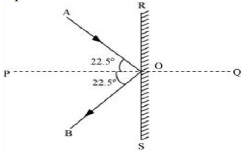
The given situation can be represented as shown in the following figure

Where, $AO =$ Incident path of the ball

$OB =$ Path followed by the ball after deflection

$\angle AOB =$ Angle between the incident and deflected paths of the ball $=45^{\circ}$

$\angle AOP =\angle BOP =22.5^{\circ}=\theta$

Initial and final velocities of the ball $=v$

Horizontal component of the initial velocity $=v \cos \theta$ along $RO$

Vertical component of the initial velocity $=v \sin \theta$ along $PO$

Horizontal component of the final velocity $=v \cos \theta$ along $OS$

Vertical component of the final velocity $=v \sin \theta$ along $OP$

The horizontal components of velocities suffer no change. The vertical components of velocities are in the opposite directions.

$\therefore$ Impulse imparted to the ball $=$ Change in the linear momentum of the ball $=m v \cos \theta-(-m v \cos \theta)$ $=2 m v \cos \theta$

Mass of the ball, $m=0.15\, kg$

Velocity of the ball, $v=54 \,km / h =15 \,m / s$

$\therefore \text { Impulse }=2 \times 0.15 \times 15 \cos 22.5^{\circ}=4.16\, kg\, m / s$
Need a full question paper?

Generate a complete, print-ready paper with questions like this in minutes — across 16+ boards, with answer keys.
Start Generating Free

Similar questions

 A lorry and a car moving with the same $K.E.$  are brought to rest by applying the same retarding force, then
$A$ uniform sphere of radius $R$ is placed on $a$ rough horizontal surface and given a linear velocity $v_0$ angular velocity $\omega_0$ as shown. The sphere comes to rest after moving some distance to the right. It follows that:
Which of the following has maximum boiling point ?
A particle starts from the origin at time $t = 0$ and moves along the positive $x-$ axis. The graph of velocity with respect to time is shown in figure. What is the position of the particle at time $t = 5\,s$ ?.........$m$
An open-ended $U$-tube of uniform cross-sectional area contains water (density $1.0 $ gram/centimeter$^3$) standing initially $20$ centimeters from the bottom in each arm. An immiscible liquid of density $4.0$ grams/ centimeter $^3$ is added to one arm until a layer $5$ centimeters high forms, as shown in the figure above. What is the ratio $h_2/h_1$ of the heights of the liquid in the two arms?
The two ends of a rod of length $L$ and a uniform cross-sectional area $A$ are kept at two temperatures $T_1$ and $T_2 (T_1 > T_2)$. The rate of heat transfer,$\frac{ dQ }{dt}$, through the rod in a steady state is given by
Two mercury drops (each of radius $r$) merge to form a bigger drop. The surface energy of the bigger drop, if $T$ is the surface tension is
A man cannot see clearly the objects beyond a distance of $20\, cm$ from his eyes. To see distant objects clearly he must use which kind of lenses and of what focal length
A metallic square loop $ABCD$ is moving in its own plane with velocity $v$ in a uniform magnetic field perpendicular to its plane as shown in the figure. An electric field is induced     
Two long straight wires are placed along $x$-axis and $y$-axis. They carry current $I_1$ and $I_2$ respectively. The equation of locus of zero magnetic induction in the magnetic field produced by them is