Question
A bird while flying takes a left turn, where does it get the centripetal force from?

Answer

The centripetal wings of bird w.r.t to air and thus the bird turns toward left.

Need a full question paper?

Generate a complete, print-ready paper with questions like this in minutes — across 16+ boards, with answer keys.
Start Generating Free

Similar questions

Suppose the density of air at Madras is $P_0$ and atomospheric pressure is $P_0$. If we go up, the density and the pressure both decrease. Suppose we wish to calculate the pressure at a height 10km above Madras. If we use the equation $P_0- P =$ pogz, will we get a pressure more than the actual or less than the actual? Neglect the variation in g. Does your answer change if you also consider the variation in g?
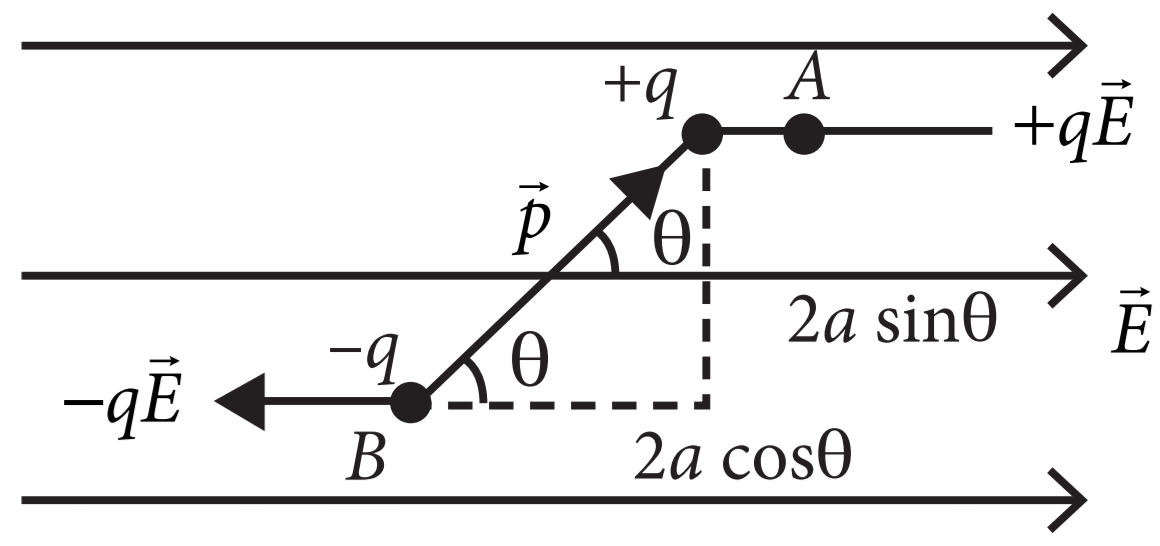
When electric dipole is placed in uniform electric field, its two charges experience equal and opposite forces, which cancel each other and hence net force on electric dipole in uniform electric field is zero. However, these forces are not collinear, so they give rise to some torque on the dipole. Since net force on electric dipole in uniform electric field is zero, so no work is done in moving the electric dipole in uniform electric field. However, some work is done in rotating the dipole against the torque acting on it.
  1. The dipole moment of a dipole in a uniform external field $\vec{\text{E}}$ is $\vec{\text{P}}.$ Then the torque 'i acting on the dipole is:
  1. $\vec{\tau}=\vec{\text{P}}\times\vec{\text{E}}$
  2. $\vec{\tau}=\vec{\text{P}}\cdot\vec{\text{E}}$
  3. $\vec{\tau}=2(\vec{\text{P}}+\vec{\text{E}})$
  4. $\vec{\tau}=(\vec{\text{P}}+\vec{\text{E}})$
  1. An electric dipole consists of two opposite charges, each of magnitude $1.0\mu\text{C}$ separated by a distance of 2.0cm. The dipole is placed in an external field of $10^5N C^{-1}$. The maximum torque on the dipole is:
  1. $0.2 \times 10^{-3}Nm$
  2. $1 \times 10^{-3}Nm$
  3. $2 \times 10^{-3}Nm$
  4. $4 \times 10^{-3}Nm$
  1. Torque on a dipole in uniform electric field is minimum when $\theta$ is equal to:
  1. 90º
  2. 180º
  3. Both (a) and (c)
  1. When an electric dipole is held at an angle in a uniform electric field, the net force F and torque t on the dipole are:
  1. $\text{F}=0, \tau=0$
  2. $\text{F}\not=0, \tau\not=0$
  3. $\text{F}=0, \tau\not=0$
  4. $\text{F}\not=0, \tau=0$
  1. An electric dipole of moment pis placed in an electric field of intensity E. The dipole acquires a position such that the axis of the dipole makes an angle $\theta$ with the direction of the field. Assuming that the potential energy of the dipole to be zero when $\theta=90^\circ$ the torque and the potential energy of the dipole will respectively be:
  1. $\text{pE}\sin\theta,-\text{pE}\cos\theta$
  2. $\text{pE}\sin\theta,-2\text{pE}\cos\theta$
  3. $\text{pE}\sin\theta,2\text{pE}\cos\theta$
  4. $\text{pE}\cos\theta,-2\text{pE}\sin\theta$
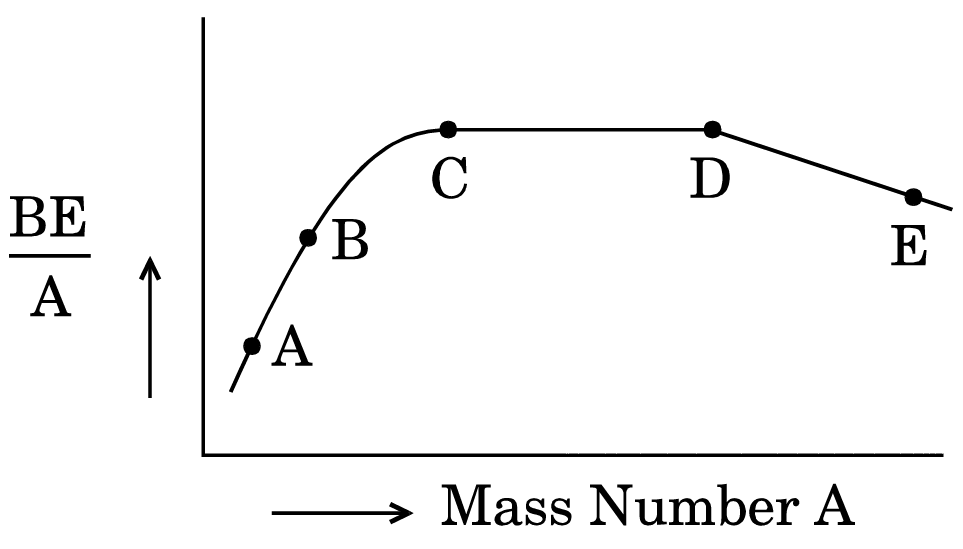
  1. The figure shows the plot of binding energy (BE) per nucleon as a function of mass number A. The letters A, B, C, D and E represent the positions of typical nuclei on the curve. Point out, giving reasons, the two processes (in terms of A, B, C, D and E), one of which can occur due to nuclear fission and the other due to nuclear fusion.
  1. Identify the nature of the radioactive radiations emitted in each step of the decay process given below.
$^{A}_{Z}\text{X}\rightarrow ^{A-4}_{Z-2}\text{Y}\rightarrow ^{A-4}_{Z-1}\text{W}$.
The electric field intensity at a point at a distance of 20 cm from the centre of a sphere is 10 Volt/meter. Find the intensity of the electric field at a point located at a distance 8 cm from the centre of that circle. The radius of the sphere is 5 cm.
Out of the two magnetic materials, 'A' has relative permeability slightly greater than unity while 'B' has less than unity. Identify the nature of the materials 'A' and 'B'. Will their susceptibilities be positive or negative?
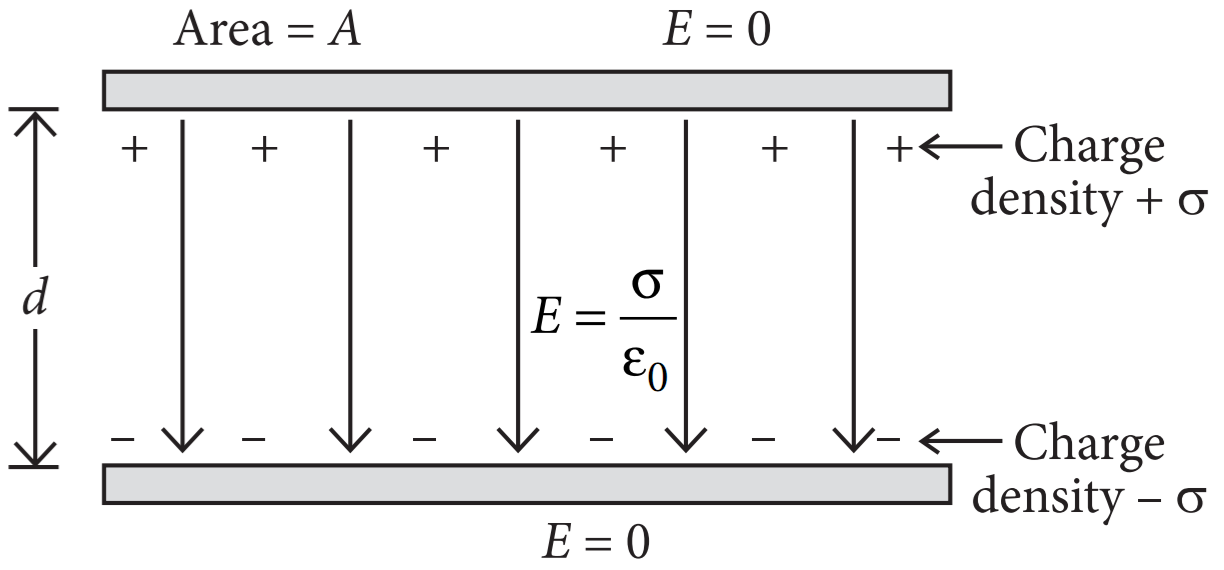
The simplest and the most widely used capacitor is the parallel plate capacitor. It consists of two large plane parallel conducting plates, separated by a small distance. In the outer regions above the upper plate and below the lower plate, the electric fields due to the two charged plates cancel out. The net field is zero. In the inner region between the two capacitor plates, the electric fields due to the two charged plates add up. The net field is $\frac{\sigma}{\in_0}.$

For a uniform electric field, potential difference between the plates = Electric field x distance between the plates. Capacitance of the parallel plate capacitor is the charge required to supplied to either of the conductors of the capacitor so as to increase the potential difference between then by unit amount.
  1. A parallel plate capacitor is charged and then isolated. The effect of increasing the plate separation on charge, potential and capacitance respectively are:
  1. Increases, decreases, decreases.
  2. Constant, increases, decreases.
  3. Constant, decreases, decreases.
  4. Constant, decreases, increases.
  1. In a parallel plate capacitor, the capacity increases if:
  1. Area of the plate is decreases.
  2. Distance between the plates increases.
  3. Area of the plate is increases.
  4. Dielectric constant decreases.
  1. A parallel plate capacitor has two square plates with equal and opposite charges. The surface charge densities on the plates are $+\sigma$ and $-\sigma$ respectively. In the region between the plates the magnitude of the electric field is:
  1. $\frac{\sigma}{2\in_0}$
  2. $\frac{\sigma}{\in_0}$
  3. 0
  4. None of these.
  1. If a parallel plate air capacitor consists of two circular plates of diameter 8cm. At what distance should the plates be held so as to have the same capacitance as that of sphere of diameter 20cm?
  1. 9mm
  2. 4mm
  3. 8mm
  4. 2mm
  1. If a charge of $+ 2.0 \times 10^{-8}C$ is placed on the positive plate and a charge of $- 1.0 \times 10^{-8}C$ on the negative plate of a parallel plate capacitor of capacitance $1.2\times10^{-3}\mu\text{F},$ then the potential difference developed between the plates is:
  1. 6.25V
  2. 3.0V
  3. 12.5V
  4. 25V
In a microwave oven, the food is kept in a plastic container and the microwave is directed towards the food. The food is cooked without melting or igniting the plastic container. Explain.
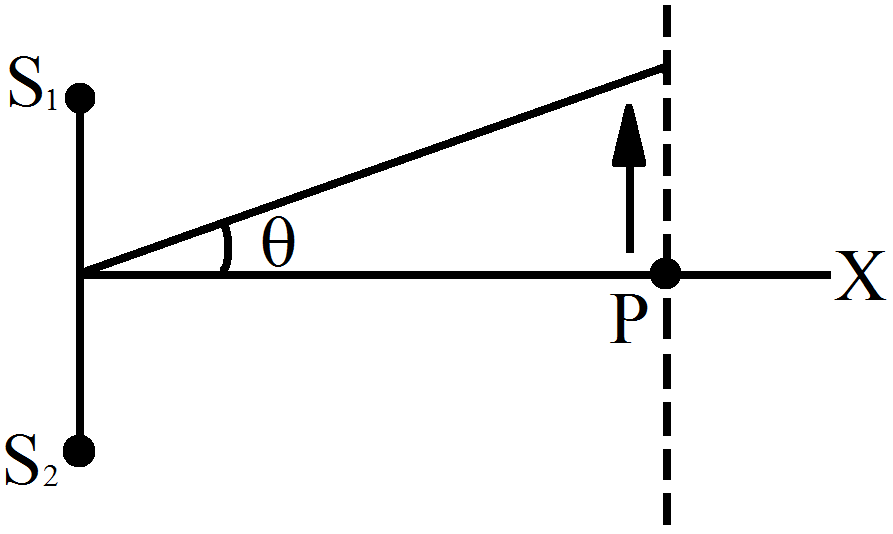
Two speakers $S_1$ and $S_2$, driven by the same amplifier, are placed at y = 1.0m and y = -1.0m figure, The speakers vibrate in phase at 600Hz. A man stands at a point on the X-axis at a very large distance from the origin and starts moving parallel to the Y-axis. The speed of sound in air is 330m/s.
  1. At what angle $\theta$ will the intensity of sound drop to a minimum for the first time?
  2. At what angle will he hear a maximum of sound intensity for the first time?
  3. If he continues to walk along the line, how many more maxima can he hear?
A lady cannot see objects closer than 40cm from the left eye and closer than 100cm from the right eye. While on a mountaineering trip, she is lost from her team. She tries to make an astronomical telscope from her reading glasses to look for her teammates.
  1. Which glass should she use as the eyepiece?
  2. What magnification can she get with relaxed eye?
A person is standing on a weighing machine placed on the floor of an elevator. The elevator starts going up with some acceleration, moves with uniform velocity for a while and finally decelerates to stop. The maximum and the minimum weights recorded are 72kg and 60kg. Assuming that the magnitudes of the acceleration and the deceleration are the same, find:
  1. The true weight of the person.
  2. The magnitude of the acceleration. Take $g = 9.9m/s^2.$