A black body radiates energy at the rate of $1 \times 10^5 J / s \times m^2$ at temperature of $227^o C$. The temperature to which it must be heated so that it radiates energy at rate of $1 \times 10^9J/s m^2$, is
Medium


Download our appand get started for free
Experience the future of education. Simply download our apps or reach out to us for more information. Let's shape the future of learning together!No signup needed.*
Similar Questions
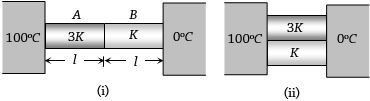
- 1Two conducting rods $A$ and $B$ of same length and cross-sectional area are connected $(i)$ In series $(ii)$ In parallel as shown. In both combination a temperature difference of $100^o C$ is maintained. If thermal conductivity of $A$ is $3K$ and that of $B$ is $K$ then the ratio of heat current flowing in parallel combination to that flowing in series combination isView Solution
- 2View SolutionSnow is more heat insulating than ice, because
- 3View SolutionOne likes to sit under sunshine in winter season, because
- 4In a room where the temperature is ${30^o}C$, a body cools from ${61^o}C$ to ${59^o}C$ in $4$ minutes. The time (in min.) taken by the body to cool from ${51^0}C$ to ${49^0}C$ will be ....... $\min$View Solution
- 5For a system with newtons law of cooling applicable the initial rate of cooling is $R^0\ C/sec$ find the time when temperature diff. $\Delta T_0 =$ initial temperature difference, is reduced to half.View Solution
- 6A partition wall has two layers $A$ and $B$ in contact, each made of a different material. They have the same thickness but the thermal conductivity of layer $A$ is twice that of layer $B$. If the steady state temperature difference across the wall is $60K$, then the corresponding difference across the layer $A$ is ....... $K$View Solution
- 7A sphere, a cube and a thin circular plate, all made of the same material and having the same mass are initially heated to a temperature of $1000°C$ . Which one of these will cool firstView Solution
- 8Match the temperature of a black body given in List-$I$ with an appropriate statement in List-$II$, and choose the correct option.View Solution
[Given: Wien's constant as $2.9 \times 10^{-3} \mathrm{~m}-\mathrm{K}$ and $\frac{\mathrm{hc}}{\mathrm{e}}=1.24 \times 10^{-6} \mathrm{~V}-\mathrm{m}$ ]
List-$I$ List-$II$ ($P$) $2000 \mathrm{~K}$ ($1$) The radiation at peak wavelength can lead to emission of photoelectrons from a metal of work function $4 \mathrm{eV}$ ($Q$) $3000 \mathrm{~K}$ ($2$) The radiation at peak wavelength is visible to human eye. ($R$) $5000 \mathrm{~K}$ ($3$) The radiation at peak emission wavelength will result in the widest central maximum of a single slit diffraction. ($S$) $10000 \mathrm{~K}$ ($4$) The power emitted per unit area is $1 / 16$ of that emitted by a blackbody at temperature $6000 \mathrm{~K}$. ($5$) The radiation at peak emission wavelength can be used to image human bones. - 9The area of the hole of heat furnace is $10^{-4}\,m^2.$ It radiates $1.58\times 10^5\,cal$ of heat per hour. If the emissivity of the furnace is $0.80,$ then its temperature is .......... $K$View Solution
- 10View SolutionIf the initial temperatures of metallic sphere and disc, of the same mass, radius and nature are equal, then the ratio of their rate of cooling in same environment will be