For a system with newtons law of cooling applicable the initial rate of cooling is $R^0\ C/sec$ find the time when temperature diff. $\Delta T_0 =$ initial temperature difference, is reduced to half.
Diffcult
Download our app for free and get started
half time $=\frac{\ln (2)}{\text { rate constant }}=\frac{\ell n (2)}{R / \Delta T_{0}}=\frac{\ell n (2) \Delta T_{0}}{R}$

Download our appand get started for free
Experience the future of education. Simply download our apps or reach out to us for more information. Let's shape the future of learning together!No signup needed.*
Similar Questions
- 1Two spheres of the same material have radii $1\ m$ and $4\ m$ and temperatures $4000\ K$ and $2000\ K$ respectively. The ratio of the energy radiated per second by the first sphere to that by the second isView Solution
- 2View SolutionUnder steady state, the temperature of a body
- 3Cooling rate of a sphere of $600\,K$ at external environment $(200\,K)$ is $R$ . When the temperature of sphere is reduced to $400\,K$ then cooling rate of the sphere becomesView Solution
- 4Two spheres of same material have radius $1m$ and $4 m$ and temperature $4000K$ and $2000K$ respectively. The energy radiated per second by the first sphere isView Solution
- 5View SolutionWhen fluids are heated from the bottom, convection currents are produced because
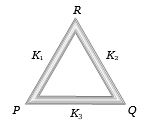
- 6hree rods of same dimensions are arranged as shown in figure they have thermal conductivities ${K_1},{K_2}$ and${K_3}$ The points $P$ and $Q$ are maintained at different temperatures for the heat to flow at the same rate along $PRQ$ and $PQ$ then which of the following option is correctView Solution
- 7A certain stellar body has radius $50 \,R_{s}$ and temperature $2 \,T_{s}$ and is at a distance of $2 \times 10^{10} \,AU$ from the earth. Here, $AU$ refers to the earth-sun distance and $R_{s}$ and $T_{s}$ refer to the sun's radius and temperature, respectively. Take, both star and sun to be ideal black bodies. The ratio of the power received on earth from the stellar body as compared to that received from the sun is close toView Solution
- 8Three very large plates of same area are kept parallel and close to each other. They are considered as ideal black surfaces and have very high thermal conductivity. The first and third plates are maintained at temperatures $2T$ and $3T$ respectively. The temperature of the middle (i.e. second) plate under steady state condition isView Solution
- 9Two rectangular blocks $A$ and $B$ of different metals have same length and same area of cross-section. They are kept in such a way that their cross-sectional area touch each other. The temperature at one end of $A$ is $100°C$ and that of $B$ at the other end is $0°C$ . If the ratio of their thermal conductivity is $1 : 3$ , then under steady state, the temperature of the junction in contact will be ........ $^oC$View Solution
- 10A long metallic bar is carrying heat from one of its ends to the other end under steady-state. The variation of temperature $\theta$ along the length $x$ of the bar from its hot end is best described by which of the following figures?View Solution