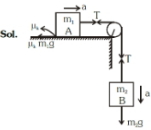
A block $A$ of mass $m_1$ rests on a horizontal table. A light string connected to it passes over a frictionless pully at the edge of table and from its other end another block $B$ of mass $m_2$ is suspended. The coefficient of kinetic friction between the block and the table is $\mu _k.$ When the block $A$ is sliding on the table, the tension in the string is
AIPMT 2015, Difficult
Download our app for free and get started
${m_2}g - T = {m_2}a$
$T - \mu k{m_1}g = {m_1}a$
$\Rightarrow a = \frac{{\left( {{m_2} - \mu \ km} \right)g}}{{{m_1} + {m_2}}}$
For the block of mass $'m{_2}'$
${m_2}g - T = {m_2}\left[ {\frac{{m - 2 - {\mu _k}}}{{{m_1} + {m_2}}}} \right]$
$g{m_2}g - T = {m_2}\left[ {\frac{{{m_2} - {\mu _k}m - 1}}{{{m_1} + {m_2}}}} \right]$
${m_2}g = {m_2}g\left[ {\frac{{{m_2} - {\mu _k}m - 1}}{{{m_1} + {M_2}}}} \right]$
$T - \mu k{m_1}g = {m_1}a$
$\Rightarrow a = \frac{{\left( {{m_2} - \mu \ km} \right)g}}{{{m_1} + {m_2}}}$
For the block of mass $'m{_2}'$
${m_2}g - T = {m_2}\left[ {\frac{{m - 2 - {\mu _k}}}{{{m_1} + {m_2}}}} \right]$
$g{m_2}g - T = {m_2}\left[ {\frac{{{m_2} - {\mu _k}m - 1}}{{{m_1} + {m_2}}}} \right]$
${m_2}g = {m_2}g\left[ {\frac{{{m_2} - {\mu _k}m - 1}}{{{m_1} + {M_2}}}} \right]$

Download our appand get started for free
Experience the future of education. Simply download our apps or reach out to us for more information. Let's shape the future of learning together!No signup needed.*
Similar Questions
- 1A heavy body of mass $25\, kg$ is to be dragged along a horizontal plane $\left( {\mu = \frac{1}{{\sqrt 3 }}} \right).$ The least force required is ........ $kgf$View Solution
- 2A force of $750 \,N$ is applied to a block of mass $102\, kg$ to prevent it from sliding on a plane with an inclination angle $30°$ with the horizontal. If the coefficients of static friction and kinetic friction between the block and the plane are $0.4 $ and $0.3$ respectively, then the frictional force acting on the block is...... $N$View Solution
- 3Consider a car moving along a straight horizontal road with a speed of $72\, km/h$. If the coefficient of kinetic friction between the tyres and the road is $0.5,$ the shortest distance in which the car can be stopped is ........ $m$ .$[g = 10\,m{s^{ - 2}}]$View Solution
- 4Statement $I :$ A cyclist is moving on an unbanked road with a speed of $7\, kmh ^{-1}$ and takes a sharp circular turn along a path of radius of $2 \,m$ without reducing the speed. The static friction coefficient is $0.2$ . The cyclist will not slip and pass the curve $\left( g =9.8\, m / s ^{2}\right)$View Solution
Statement $II :$ If the road is banked at an angle of $45^{\circ}$, cyclist can cross the curve of $2\, m$ radius with the speed of $18.5\, kmh ^{-1}$ without slipping.
In the light of the above statements, choose the correct answer from the options given below.
- 5A block of mass $M$ slides down on a rough inclined plane with constant velocity. The angle made by the incline plane with horizontal is $\theta$. The magnitude of the contact force will be.View Solution
- 6$A$ block of mass $M$ is placed on $a$ horizontal surface and it is tied with an inextensible string to $a$ block of mass, as shown in figure. A block of mass $m_0$ is also placed on $M$ If friction force exists between the block $M$ and the block $m_0$ and not between the block $M$ and the horizontal surface, then the minimum value of $\mu$ for which the block m remains stationary isView Solution

- 7$A$ block of mass $M$ is placed on $a$ horizontal surface and it is tied with an inextensible string to $a$ block of mass, as shown in figure. A block of mass $m_0$ is also placed on $M$ If there is no friction between any two surfaces, thenView Solution

- 8If the radius of curvature of the path of two particles of same mass are in the ratio $3:4,$ then in order to have constant centripetal force, their velocities will be in the ratio of:View Solution
- 9A block of mass $0.1 \,kg$ is held against a wall by applying a horizontal force of $5\, N$ on the block. If the coefficient of friction between the block and the wall is $0.5$, the magnitude of the frictional force acting on the block is ........ $N$View Solution
- 10A curved in a level road has a radius $75\, m$. The maximum speed of a car turning this curved road can be $30 \,m / s$ without skidding. If radius of curved road is changed to $48\, m$ and the coefficient of friction between the tyres and the road remains same, then maximum allowed speed would be .........$m / s$.View Solution