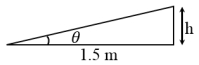
A train is moving with a speed of $12 \mathrm{~m} / \mathrm{s}$ on rails which are $1.5 \mathrm{~m}$ apart. To negotiate a curve radius $400 \mathrm{~m}$, the height by which the outer rail should be raised with respect to the inner rail is (Given, $g=$ $10 \mathrm{~m} / \mathrm{s}^2$ ) :
JEE MAIN 2024, Diffcult


Download our appand get started for free
Experience the future of education. Simply download our apps or reach out to us for more information. Let's shape the future of learning together!No signup needed.*
Similar Questions
- 1A block of mass $0.1 \,kg$ is held against a wall by applying a horizontal force of $5\, N$ on the block. If the coefficient of friction between the block and the wall is $0.5$, the magnitude of the frictional force acting on the block is ........ $N$View Solution
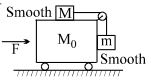
- 2Imagine $a$ situation in which the horizontal surface of block $M_0$ is smooth and its vertical surface is rough with $a$ coefficient of friction $\mu$ Consider a special situation in which both the faces of the block $M_0$ are smooth, as shown in adjoining figure. Mark out the correct statement $(s)$View Solution
- 3A car having a mass of $1000\, kg$ is moving at a speed of $30\, metres/sec$. Brakes are applied to bring the car to rest. If the frictional force between the tyres and the road surface is $5000$ newtons, the car will come to rest in ........ $\sec$View Solution
- 4A marble block of mass $2\, kg$ lying on ice when given a velocity of $6\, m/s$ is stopped by friction in $10s$. Then the coefficient of friction is-View Solution
- 5A marble block of mass $2\, kg$ lying on ice when given a velocity of $6\, m/s$ is stopped by friction in $10s$. Then the coefficient of friction is-View Solution
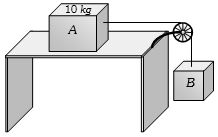
- 6If mass of $A = 10\,\,kg$, coefficient of static friction $= 0.2$, coefficient of kinetic friction = $0.2$. Then mass of $B$ to start motion isView Solution
- 7A boy is sitting on the horizontal platform of a joy wheel at a distance of $5 \,m$ from the center. The wheel begins to rotate and when the angular speed exceeds $1 \,rad / s$, the boy just slips. The coefficient of friction between the boy and the wheel is $\left(g=10 \,m / s ^2\right)$View Solution
- 8One end of string of length $l$ is connected to a particle of mass $'m'$ and the other end is connected to a small peg on a smooth horizontal table. If the particle moves in circle with speed $'v',$ the net force on the particle (directed towards centre) will be ($T$ represents the tension in the string)View Solution
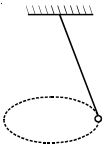
- 9In a conical pendulum, the bob is rotated with different angular velocities and tension in the string is calculated for different values of $\omega$ . Which of them is correct graph between $T$ & $\omega .$View Solution
- 10Starting from rest a body slides down a $45^o$ inclined plane in twice the time it takes to slide down the same distance in the absence of friction. The co-efficient of friction between the body and the inclined plane is:View Solution