Starting from rest, a body slides down a $45^°$ inclined plane in twice the time it takes to slide down the same distance in the absence of friction. The coefficient of friction between the body and the inclined plane is
AIPMT 1990, Diffcult


Download our appand get started for free
Experience the future of education. Simply download our apps or reach out to us for more information. Let's shape the future of learning together!No signup needed.*
Similar Questions
- 1View SolutionA homogeneous rectangular brick lies on a rough inclined plane of very small inclination. Which half part of brick exters greater contact force on plane
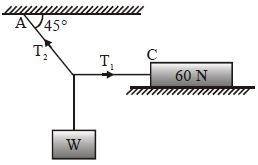
- 2In the figure, a block of weight $60\, N$ is placed on a rough surface. The coefficient of friction between the block and the surfaces is $0.5$. ........ $N$ should be the maximum weight $W$ such that the block does not slip on the surface .View Solution
- 3A bullet of mass $4\,g$ is fired horizontally with a speed of $300\,m/s$ into $0.8\,kg$ block of wood at rest on a table. If the coefficient of friction between the block and the table is $0.3,$ how far will the block slide approximately?View Solution
- 4A force $F = Kt$ (where $t$ is the time in seconds and $K = 2\, N/s$) is applied on $2 \,kg$ block at $t = 0$ as shown in the figure. The displacement of $8\ kg$ block till the time when $2\, kg$ block start slipping on $8\,kg$ block will be (coefficient of friction between $2\,kg$ block and $8\, kg$ block is $0.2$ and between $8\, kg$ block and surface is zero,View Solution
$g = 10m/s^2)$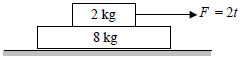
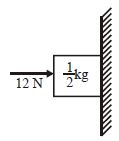
- 5A horizontal force $12 \,N$ pushes a block weighing $1/2\, kg$ against a vertical wall. The coefficient of static friction between the wall and the block is $0.5$ and the coefficient of kinetic friction is $0.35.$ Assuming that the block is not moving initially. Which one of the following choices is correct (Take $g = 10 \,m/s^2$)View Solution
- 6View SolutionThe maximum static frictional force is
- 7A block of mass $m$ rests on a rough inclined plane. The coefficient of friction between the surface and the block is $\mu$. At what angle of inclination $\theta$ of the plane to the horizontal will the block just start to slide down the plane?View Solution
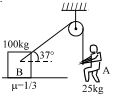
- 8Block $B$ of mass $100 kg$ rests on a rough surface of friction coefficient $\mu = 1/3$. $A$ rope is tied to block $B$ as shown in figure. The maximum acceleration with which boy $A$ of $25 kg$ can climbs on rope without making block move is:View Solution
- 9A cyclist riding the bicycle at a speed of $14 \sqrt{3} \,m / s$ takes a turn around a circular road of radius $20 \sqrt{3} \,m$ without skidding. What is his inclination to the vertical?View Solution
- 10One end of string of length $l$ is connected to a particle of mass $'m'$ and the other end is connected to a small peg on a smooth horizontal table. If the particle moves in circle with speed $'v',$ the net force on the particle (directed towards centre) will be ($T$ represents the tension in the string)View Solution