A block of $1\, kg$ is stopped against a wall by applying a force $F$ perpendicular to the wall. If $\mu = 0.2$ then minimum value of $F$ will be ....... $N.$
Easy
Download our app for free and get started
(b)$F = \frac{W}{\mu } = \frac{{1 \times 9.8}}{{0.2}} = 49\,N$

Download our appand get started for free
Experience the future of education. Simply download our apps or reach out to us for more information. Let's shape the future of learning together!No signup needed.*
Similar Questions
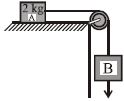
- 1The coefficient of static friction, $\mu _s$ between block $A$ of mass $2\,kg$ and the table as shown in the figure is $0.2$. What would be the maximum mass value of block $B$ so that the two blocks $B$ so that the two blocks do not move? The string and the pulley are assumed to be smooth and masseless ....... $kg$ $(g = 10\,m/s^2)$View Solution
- 2A $2\,kg$ block slides on a horizontal floor with a speed of $4\, m/s$. It strikes a uncompressed spring, and compresses it till the block is motionless. The kinetic friction force is $110\,N$ and spring constant is $1000\, N/m$. The spring compresses by ........ $cm$View Solution
- 3Starting from rest, a body slides down a $45^°$ inclined plane in twice the time it takes to slide down the same distance in the absence of friction. The coefficient of friction between the body and the inclined plane isView Solution
- 4A block weighs $W$ is held against a vertical wall by applying a horizontal force $F$. The minimum value of $F$ needed to hold the block is $[\mu < 1]$View Solution
- 5A train is moving with a speed of $12 \mathrm{~m} / \mathrm{s}$ on rails which are $1.5 \mathrm{~m}$ apart. To negotiate a curve radius $400 \mathrm{~m}$, the height by which the outer rail should be raised with respect to the inner rail is (Given, $g=$ $10 \mathrm{~m} / \mathrm{s}^2$ ) :View Solution
- 6If the radius of curvature of the path of two particles of same mass are in the ratio $3:4,$ then in order to have constant centripetal force, their velocities will be in the ratio of:View Solution
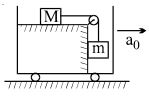
- 7Imagine the situation in which the given arrangement is placed inside a trolley that can move only in the horizontal direction, as shown in figure. If the trolley is accelerated horizontally along the positive $x$ -axis with $a_0$, then Choose the correct statement $(s)$.View Solution
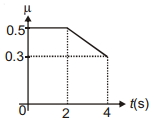
- 8A block is projected with speed $20 \,m / s$ on a rough horizontal surface. The coefficient of friction $(\mu)$ between the surfaces varies with time $(t)$ as shown in figure. The speed of body at the end of $4$ second will be ............ $m / s$ ( $g=$ $10 \,m / s ^2$ )View Solution
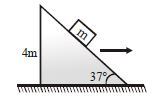
- 9If the coefficient of friction between block & wedge is $\mu $, then the maximum horizontal acceleration of the wedge for which block will remain at rest w.r.t. the wedge isView Solution
- 10A block is at rest on an inclined plane making an angle $\alpha $ with the horizontal. As the angle $\alpha $ of the incline is increased, the block starts slipping when the angle of inclination becomes $\theta $. The coefficient of static friction between the block and the surface of the inclined plane isView Solution