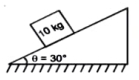
A block of mass $10 \,kg$ is kept on a fixed rough $(\mu=0.8)$ inclined plane of angle of inclination $30^{\circ}$. The frictional force acting on the block is ........... $N$
Easy
Download our app for free and get started
(a)
$F=m g \sin \theta$
Where, $m=$ mass
$g =$ acceleration due to gravity
Put the value into the formula
$F=10 \times 9.8 \times \sin 30^{\circ}$
$F \approx 50\,N$

Download our appand get started for free
Experience the future of education. Simply download our apps or reach out to us for more information. Let's shape the future of learning together!No signup needed.*
Similar Questions
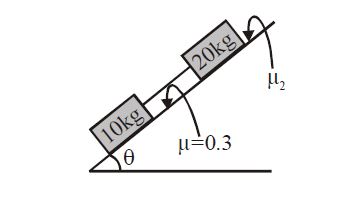
- 1Value of $\theta$ is increased gradually from $\theta = 0$ At $\theta=tan^{-1}(\frac{1}{2})$ both the block just start slipping. Then value of $\mu_2$ is : $(g = 10 m/s^2)$View Solution
- 2The force required just to move a body up an inclined plane is double the force required just to prevent the body from sliding down. If $\mu $ is the coefficient of friction, the inclination of plane to the horizontal isView Solution
- 3A force of $19.6\, N$ when applied parallel to the surface just moves a body of mass $10 \,kg$ kept on a horizontal surface. If a $5\, kg$ mass is kept on the first mass, the force applied parallel to the surface to just move the combined body is........ $N.$View Solution
- 4A body of mass $100\, g$ is sliding from an inclined plane of inclination $30^°$. What is the frictional force experienced if $\mu = 1.7$View Solution
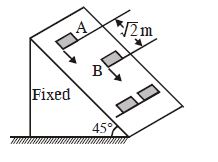
- 5Two blocks $A$ and $B$ of equal masses are sliding down along straight parallel lines on an inclined plane of $45^o$ . Their coefficients of kinetic friction are $\mu _A = 0.2$ and $\mu _B = 0.3$ respectively. At $t = 0$ , both the blocks are at rest and block $A$ is $\sqrt 2$ metre behind block $B$ . The time and distance from the initial position where the front faces of the blocks come in line on the inclined plane as shown in figure. (Use $g = 10\, ms^{-2}$ )View Solution
- 6A block of weight $1 \,N$ rests on an inclined plane of inclination $\theta$ with the horizontal. The coefficient of friction is $\mu$ The minimum force that has to be applied parallel to the inclined plane to make the body just move up the plane isView Solution
- 7A block is placed on a rough horizontal plane. A time dependent horizontal force $F = Kt$ acts on the block. Here $K$ is a positive constant. Acceleration-time graph of the block isView Solution
- 8On the horizontal surface of a truck a block of mass $1 \;kg$ is placed $(\mu=0.6)$ and truck is moving with acceleration $5\; m / sec ^2$ then the frictional force on the block will beView Solution
- 9A body of mass $2 \,kg$ is kept by pressing to a vertical wall by a force of $100\, N$. The coefficient of friction between wall and body is $0.3.$ Then the frictional force is equal to ........ $N$View Solution
- 10A block of mass $m$ is on an inclined plane of angle $\theta$. The coefficient of friction between the block and the plane is $\mu$ and $\tan \theta>\mu$. The block is held stationary by applying a force $\mathrm{P}$ parallel to the plane. The direction of force pointing up the plane is taken to be positive. As $\mathrm{P}$ is varied from $\mathrm{P}_1=$ $m g(\sin \theta-\mu \cos \theta)$ to $P_2=m g(\sin \theta+\mu \cos \theta)$, the frictional force $f$ versus $P$ graph will look likeView Solution