A force of $19.6\, N$ when applied parallel to the surface just moves a body of mass $10 \,kg$ kept on a horizontal surface. If a $5\, kg$ mass is kept on the first mass, the force applied parallel to the surface to just move the combined body is........ $N.$
Medium
Download our app for free and get started
(a) ${F_l} \propto R$ $\therefore $ ${F_l} \propto m$ i.e. limiting friction depends upon the mass of body. So, $\frac{{({F_l})\,\prime }}{{({F_l})}} = \frac{{m'}}{m} = \frac{{10 + 5}}{{10}}$
==>$({F_l})\,\prime = \frac{3}{2} \times {F_l} = \frac{3}{2} \times 19.6 = 29.4\;N$

Download our appand get started for free
Experience the future of education. Simply download our apps or reach out to us for more information. Let's shape the future of learning together!No signup needed.*
Similar Questions
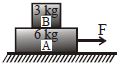
- 1Two blocks $A$ and $B$ of masses $6\, kg$ and $3\, kg$ rest on a smooth horizontal surface as shown in the figure. If coefficient of friction between $A$ and $B$ is $0.4$, the maximum horizontal force which can make them without separation is ........ $N$View Solution
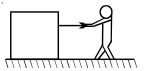
- 2View SolutionA man pulls a block heavier than himself with a light horizontal rope. The coefficient of friction is the same between the man and the ground, and between the block and the ground
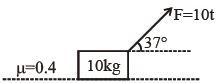
- 3View SolutionA force acts on a block as shown in figure. Find time when block loses contact with surface.
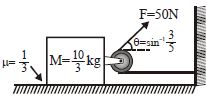
- 4In the given figure the acceleration of $M$ is $(g = 10 \,ms^{-2})$View Solution
- 5A body of $5 \,kg$ weight kept on a rough inclined plane of angle $30^{\circ}$ starts sliding with a constant velocity. Then the coefficient of friction is (assume $g=10 \,ms ^{-2}$ )View Solution
- 6A heavy box is solid across a rough floor with an initial speed of $4 \,m / s$. It stops moving after $8$ seconds. If the average resisting force of friction is $10 \,N$, the mass of the box (in $kg$ ) is .....View Solution
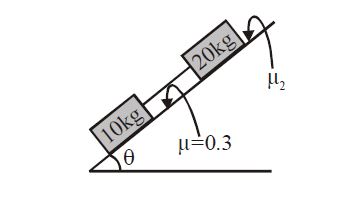
- 7Value of $\theta$ is increased gradually from $\theta = 0$ At $\theta=tan^{-1}(\frac{1}{2})$ both the block just start slipping. Then value of $\mu_2$ is : $(g = 10 m/s^2)$View Solution
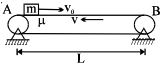
- 8With what minimum velocity should block be projected from left end $A$ towards end $B$ such that it reaches the other end $B$ of conveyer belt moving with constant velocity $v$. Friction coefficient between block and belt is $\mu$ .View Solution
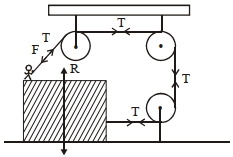
- 9A boy of mass $4\, kg$ is standing on a piece of wood having mass $5 \,kg$. If the coefficient of friction between the wood and the floor is $0.5,$ the maximum force that the boy can exert on the rope so that the piece of wood does not move from its place is ......$N.$(Round off to the Nearest Integer) [Take $g=10 \,ms ^{-2}$ ]View Solution
- 10A $2 \,kg$ mass starts from rest on an inclined smooth surface with inclination $30^°$ and length $2\, m$. ...... $m$ will it travel before coming to rest on a frictional surface with frictional coefficient of $0.25$View Solution