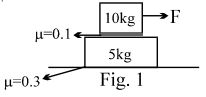
When $F = 2N$, the frictional force between $10 kg$ block and $5 kg$ block is ...... $N$
Difficult
Download our app for free and get started

Download our appand get started for free
Experience the future of education. Simply download our apps or reach out to us for more information. Let's shape the future of learning together!No signup needed.*
Similar Questions
- 1Find the maximum velocity for skidding for a car moved on a circular track of radius $100\, m$. The coefficient of friction between the road and tyre is $0.2$ ....... $m/s$View Solution
- 2A motor car has a width $1.1$ m between wheels. Its centre of gravity is $0.62$ m above the ground and the coefficient of friction between the wheels and the road is $0.8$. ...... $m/s$ is the maximum possible speed, if the centre of gravity inscribes a circle of radius $15$ m ? (Road surface is horizontal)View Solution
- 3View SolutionIn a tonga, horse pulls a wagon. Which is the correct analysis of the situation?
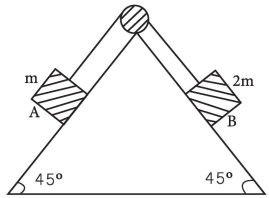
- 4Consider the diagram shown below in which two masses of $m$ and $2 m$ are placed on a fixed triangular wedge. The coefficient of friction between block $A$ and the wedge is $2 / 3$, while that for block $B$ and the wedge is $1 / 3$View Solution
- 5An object of mass $1 \,kg$ moving on a horizontal surface with initial velocity $8 \,m / s$ comes to rest after $10 \,s$. If one wants to keep the object moving on the same surface with velocity $8 \,m / s$ the force required is ...... $N$View Solution
- 6Put a uniform meter scale horizontally on your extended index fingers with the left one at $0.00 cm$ and the right one at $90.00 cm$. When you attempt to move both the fingers slowly towards the center, initially only the left finger slips with respect to the scale and the right finger does not. After some distance, the left finger stops and the right one starts slipping. Then the right finger stops at a distance $x_R$ from the center ( $50.00 cm$ ) of the scale and the left one starts slipping again. This happens because of the difference in the frictional forces on the two fingers. If the coefficients of static and dynamic friction between the fingers and the scale are $0.40$ and $0.32$ , respectively, the value of $x_R($ in $cm )$ is. . . . . . .View Solution
- 7A coin placed on a rotating table just slips when it is placed at a distance of $1\,cm$ from the center. If the angular velocity of the table in halved, it will just slip when placed at a distance of from the centre $............\,cm$View Solution
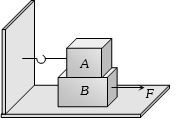
- 8A block A with mass $100\, kg $ is resting on another block $B$ of mass $200\, kg$. As shown in figure a horizontal rope tied to a wall holds it. The coefficient of friction between $A$ and $B$ is $ 0.2 $ while coefficient of friction between $B$ and the ground is $0.3$. The minimum required force $F$ to start moving $B$ will be ........ $N$View Solution
- 9A brick of mass $2\, kg$ begins to slide down on a plane inclined at an angle of $45^° $ with the horizontal. The force of friction will beView Solution
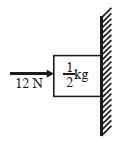
- 10A horizontal force $12 \,N$ pushes a block weighing $1/2\, kg$ against a vertical wall. The coefficient of static friction between the wall and the block is $0.5$ and the coefficient of kinetic friction is $0.35.$ Assuming that the block is not moving initially. Which one of the following choices is correct (Take $g = 10 \,m/s^2$)View Solution