A block of mass $10\, kg$ moving at $10\,m/s$ is released to slide on rough surface having coefficient of friction $0.2.$ It will stop by travelling distance ........ $m$
Medium


Download our appand get started for free
Experience the future of education. Simply download our apps or reach out to us for more information. Let's shape the future of learning together!No signup needed.*
Similar Questions
- 1A car is moving on a circular path and takes a turn. If ${R_1}$ and ${R_2}$ be the reactions on the inner and outer wheels respectively, thenView Solution
- 2A block of mass $m$ rests on a rough inclined plane. The coefficient of friction between the surface and the block is $\mu$. At what angle of inclination $\theta$ of the plane to the horizontal will the block just start to slide down the plane?View Solution
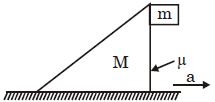
- 3As shown in the figure, block m and wedge $M$ move together with a horizontal acceleration of $20\, m/s^2$. Given $m = 1\, kg$, $\mu = 0.6$ (between $m$ and $M$) and $g = 10\, m/s^2$. Choose the $CORRECT$ alternative :-View Solution
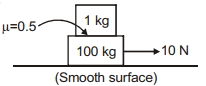
- 4The frictional force acting on $1 \,kg$ block is .................. $N$View Solution
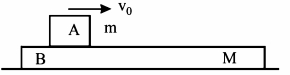
- 5The masses of blocks A and B are $m$ and $M$ respectively. Between $A$ and $B$, there is a constant frictional force $F$ and $B$ can slide on a smooth horizontal surface. A is set in motion with velocity while $B$ is at rest. What is the distance moved by A relative to $B$ before they move with the same velocity?View Solution
- 6A wooden block of mass $M$ resting on a rough horizontal surface is pulled with a force $F$ at an angle $\phi $ with the horizontal. If $\mu $ is the coefficient of kinetic friction between the block and the surface, then acceleration of the block isView Solution
- 7A mass is supported on a frictionless horizontal surface. It is attached to a string and rotates about a fixed centre at an angular velocity ${\omega _0}$. If the length of the string and angular velocity are doubled, the tension in the string which was initially ${T_0}$ is nowView Solution
- 8$A$ block placed on a rough inclined plane of inclination $(\theta =30^o)$ can just be pushed upwards by applying $a$ force $"F"$ as shown. If the angle of inclination of the inclined plane is increased to $(\theta = 60^o)$, the same block can just be prevented from sliding down by application of a force of same magnitude. Thecoefficient of friction between the block and the inclined plane isView Solution

- 9A cyclist goes round a circular path of circumference $34.3\, m$ in $\sqrt {22} $ sec. the angle made by him, with the vertical, will be ....... $^o$View Solution
- 10Calculate the maximum acceleration (in $m s ^{-2}$) of a moving car so that a body lying on the floor of the car remains stationary. The coefficient of static friction between the body and the floor is $0.15$ $\left( g =10 m s ^{-2}\right)$.View Solution