MCQ
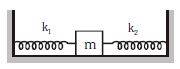
A block of mass $m$ is attached to two springs of spring constants $k_1$ and $k_2$ as shown in figure. The block is displaced by $x$ towards right and released. The velocity of the block when it is at $x/2$ will be
  • A
    $\sqrt {\frac{{\left( {{k_1} + {k_2}} \right){x^2}}}{{2m}}} $
  • $\sqrt {\frac{3}{4}\frac{{\left( {{k_1} + {k_2}} \right){x^2}}}{m}} $
  • C
    $\sqrt {\frac{{\left( {{k_1} + {k_2}} \right){x^2}}}{m}} $
  • D
    $\sqrt {\frac{{\left( {{k_1} + {k_2}} \right){x^2}}}{4m}} $

Answer

Correct option: B.
$\sqrt {\frac{3}{4}\frac{{\left( {{k_1} + {k_2}} \right){x^2}}}{m}} $
b

Need a full question paper?

Generate a complete, print-ready paper with questions like this in minutes — across 16+ boards, with answer keys.

Start Generating Free

Similar questions

${v_1}$ and ${v_2}$ are the velocities of sound at the same temperature in two monoatomic gases of densities ${\rho _1}$ and ${\rho _2}$ respectively. If $\frac{\rho _1}{\rho _2} = \frac{1}{4}$ then the ratio of velocities ${v_1}$ and ${v_2}$ will be
A particle of mass $ 0.3 \,kg$ is subjected to a force $F = - kx$ with $k = 15\,N/m.$ What will be its initial acceleration if it is released from a point $20 \,cm$ away from the origin .......... $m/s^2$
A bowl filled with very hot soup cools from $98^{\circ}\,C$ to $86^{\circ}\,C$ in $2$ minutes when the room temperature is $22^{\circ}\,C$. $..........\,minutes$ long it will take to cool from $75^{\circ}\,C$ to $69^{\circ}\,C$ ?
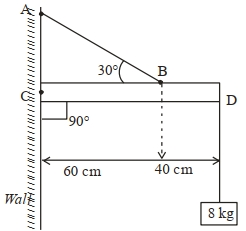
An object of mass $8\,kg$ is hanging from one end of a uniform rod $CD$ of mass $2\,kg$ and length $1\,m$ pivoted at its end $C$ on a vertical wall as shown in figure. It is supported by a cable $A B$ such that the system is in equilibrium. The tension in the cable is $............\,N$ (Take $g=10\,m / s ^2$ )
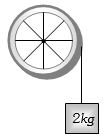
A block of mass $2\,kg$ hangs from the rim of a wheel of radius $0.5\,m$. On releasing from rest the block falls through $5\,m$ height in $2\,s$. The moment of inertia of the wheel will be ...... $kg - {m^2}$
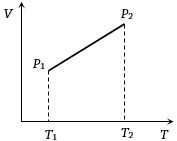
From the following $V-T$ diagram we can conclude
The dimensions of $RC$ is

($C$ and $R$ represent capacitance and resistance respectively)

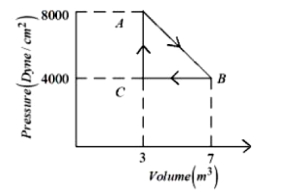
A thermodynamic system is taken from an original state $A$ to an intermediate state $B$ by a linear process as shown in the figure. It's volume is then reduced to the original value from $B$ to $C$ by an isobaric process. The total work done by the gas from $A$ to $B$ and $B$ to $C$ would be :
The distance of a particle moving on a circle of radius $12 \,m$ measured from a fixed point on the circle and measured along the circle is given by $s=2 t^3$ (in meters). The ratio of its tangential to centripetal acceleration at $t=2 \,s$ is .........
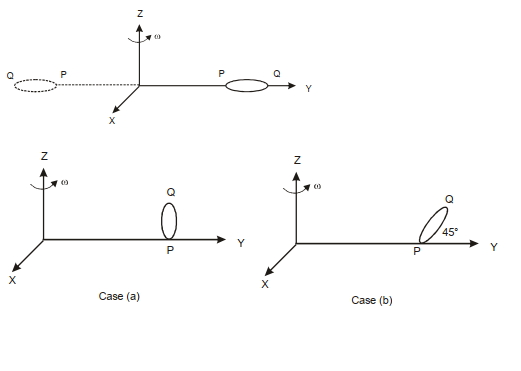
The general motion of a rigid body can be considered to be a combination of $(i)$ a motioon --- centre of mass about an axis, and $(ii)$ its motion about an instantanneous axis passing through center of mass. These axes need not be stationary. Consider, for example, a thin uniform welded (rigidly fixed) horizontally at its rim to a massless stick, as shown in the figure. Where disc-stick system is rotated about the origin ona horizontal frictionless plane with angular sp--- $\omega$, the motion at any instant can be taken as a combination of $(i)$ a rotation of the centre of mass the disc about the $z$-axis, and $(ii)$ a rotation of the disc through an instantaneous vertical axis pass through its centre of mass (as is seen from the changed orientation of points $P$ and $Q$). Both the motions have the same angular speed $\omega$ in the case. $Image$  Now consider two similar systems as shown in the figure: case $(a)$ the disc with its face ver--- and parallel to $x - z$ plane; Case $(b)$ the disc with its face making an angle of $45^{\circ}$ with $x$-y plane its horizontal diameter parallel to $x$-axis. In both the cases, the disc is weleded at point $P$, and systems are rotated with constant angular speed $\omega$ about the $z$-axis.$Image$

$1.$ Which of the following statement regarding the angular speed about the istantaneous axis (passing through the centre of mass) is correct?

$(A)$ It is $\sqrt{2} \omega$ for boht the cases

$(B)$ it is $\omega$ for case $(a)$; and $\frac{w}{\sqrt{2}}$ for case $(b)$.

$(C)$ It is $\omega$ for case $(a)$; and $\sqrt{2} \omega$ for case $(b)$.

$(D)$ It is $\omega$ for both the cases

$2.$ Which of the following statements about the instantaneous axis (passing through the centre of mass) is correct?

$(A)$ It is vertical for both the cases $(a)$ and $(b)$.

$(B)$ It is verticle for case $(a)$; and is at $45^{\circ}$ to the $x-z$ plane and lies in the plane of the disc for case $(b)$

$(C)$ It is horizontal ofr case $(a)$; and is at $45^{\circ}$ to the $x - z$ plane and is normal to the plane of the disc for case $(b)$.

$(D)$ It is vertical of case $(a)$; and is at $45^{\circ}$ to the $x - z$ plane and is normal to the plane of the disc for case $(b)$.

Give the answer question $1$ and $2.$