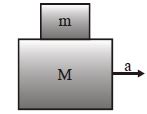
A block of mass $m$ is placed on the top of another block of mass $M$ as shown in the figure. The coefficient of friction between them is $\mu $. What is the maximum acceleration with which the block $M$ may move so that m also moves along with it ?
Easy


Download our appand get started for free
Experience the future of education. Simply download our apps or reach out to us for more information. Let's shape the future of learning together!No signup needed.*
Similar Questions
- 1A block of mass $M$ is being pulled along rough horizontal surface. The coefficient of friction between the block and the surface is $\mu $. If another block of mass $M/2$ is placed on the block and it is again pulled on the surface, the coefficient of friction between the block and the surface will beView Solution
- 2View SolutionA car when passes through a convex bridge exerts a force on it which is equal to
- 3One end of string of length $l$ is connected to a particle of mass $'m'$ and the other end is connected to a small peg on a smooth horizontal table. If the particle moves in circle with speed $'v',$ the net force on the particle (directed towards centre) will be ($T$ represents the tension in the string)View Solution
- 4A body of mass $2$ kg is moving on the ground comes to rest after some time. The coefficient of kinetic friction between the body and the ground is $0.2$. The retardation in the body is ...... $m/s^2$View Solution
- 5View SolutionA metal block is resting on a rough wooden surface. A horizontal force applied to the block is increased uniformly. Which of the following curves correctly represents velocity of the block ?
- 6A heavy box of mass $50 \mathrm{~kg}$ is moving on a horizontal surface. If co-efficient of kinetic friction between the box and horizontal surface is $0.3$ then force of kinetic friction is :View Solution
- 7A force $F = Kt$ (where $t$ is the time in seconds and $K = 2\, N/s$) is applied on $2 \,kg$ block at $t = 0$ as shown in the figure. The displacement of $8\ kg$ block till the time when $2\, kg$ block start slipping on $8\,kg$ block will be (coefficient of friction between $2\,kg$ block and $8\, kg$ block is $0.2$ and between $8\, kg$ block and surface is zero,View Solution
$g = 10m/s^2)$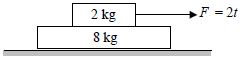
- 8A particle is moving in a circle of radius $R$ with constant speed $v$, if radius is double then its centripetal force to keep the same speed should beView Solution
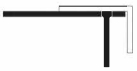
- 9A uniform rope of total length $l$ is at rest on a table with fraction $f$ of its length hanging (see figure). If the coefficient of friction between the table and the chain is $\mu$, thenView Solution
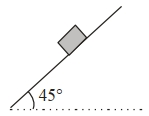
- 10Consider a block kept on an inclined plane (inclined at $45^{\circ}$ ) as shown in the figure. If the force required to just push it up the incline is $2$ times the force required to just prevent it from sliding down, the coefficient of friction between the block and inclined plane $(\mu)$ is equal toView Solution