A body of mass $2$ kg is moving on the ground comes to rest after some time. The coefficient of kinetic friction between the body and the ground is $0.2$. The retardation in the body is ...... $m/s^2$
Easy


Download our appand get started for free
Experience the future of education. Simply download our apps or reach out to us for more information. Let's shape the future of learning together!No signup needed.*
Similar Questions
- 1A block of wood resting on an inclined plane of angle $30^o$, just starts moving down. If the coefficient of friction is $0.2$, its velocity (in $ms^{-1}$) after $5\, seconds$ is : $(g = 10\, ms^{-2})$View Solution
- 2At time $t=0$, a disk of radius $1 m$ starts to roll without slipping on a horizontal plane with an angular acceleration of $\alpha=\frac{2}{3} rad s ^{-2}$. A small stone is stuck to the disk. At $t=0$, it is at the contact point of the disk and the plane. Later, at time $t=\sqrt{\pi} s$, the stone detaches itself and flies off tangentially from the disk. The maximum height (in $m$ ) reached by the stone measured from the plane is $\frac{1}{2}+\frac{x}{10}$. The value of $x$ is. . . . . . .[Take $g=10 m s ^{-2}$.]View Solution
- 3$Assertion$ : Mountain roads rarely go straight up the slope.View Solution
$Reason$ : Slope of mountains are large, therefore more chances of vehicle to slip from roads - 4View SolutionWhich of the following statements is not true
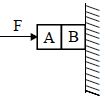
- 5Given in the figure are two blocks $A$ and $B$ of weight $20\, N$ and $100\, N$, respectively. These are being pressed against a wall by a force $F$ such that the system does not slide as shown. If the coefficient of friction between the blocks is $0.1$ and between block $B$ and the wall is $0.15$, the frictional force applied by the wall on block $B$ is ........ $N$View Solution
- 6A block of mass $2 \,kg$ rests on a rough inclined plane making an angle of $30°$ with the horizontal. The coefficient of static friction between the block and the plane is $ 0.7$. The frictional force on the block is ....... $N$.View Solution
- 7Two blocks $A$ and $B$ are released from the top of a rough inclined plane so that $A$ slides along the plane and $B$ falls down freely. Which will have higher velocity on reaching the ground ?View Solution
- 8A block of mass $m$ is placed on a surface having vertical cross section given by $y=x^2 / 4$. If coefficient of friction is $0.5$ , the maximum height above the ground at which block can be placed without slipping is:View Solution
- 9A body of mass $\mathrm{m}$ is kept on a rough horizontal surface (coefficient of friction $=\mu$ ) A horizontal force is applied on the body, but it does not move. The resultant of normal reaction and the frictional force acting on the object is given by $\mathrm{F},$ where $\mathrm{F}$ isView Solution
- 10A body of $10\, kg$ is acted by a force of $129.4\, N$ if $g = 9.8\,m/{\sec ^2}$. The acceleration of the block is $10\,m/{s^2}$. What is the coefficient of kinetic frictionView Solution