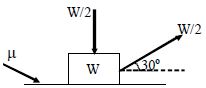
A block of weight $W$ is kept on a rough horizontal surface (friction coefficient $\mu$). Two forces $W/2$ each are applied as shown in the figure. Choose the $CORRECT$ statement :-
Difficult
Download our app for free and get started
$\mathrm{N}=\mathrm{W}+\frac{\mathrm{W}}{2}-\frac{\mathrm{W}}{4}=\frac{5}{4} \mathrm{W}$
$\frac{5}{4} \mathrm{W} \cdot \mu=\frac{\mathrm{W}}{2} \cdot \frac{\sqrt{3}}{2} \Rightarrow \mu=\frac{\sqrt{3}}{5}$

Download our appand get started for free
Experience the future of education. Simply download our apps or reach out to us for more information. Let's shape the future of learning together!No signup needed.*
Similar Questions
- 1A block of mass $M$ is being pulled along rough horizontal surface. The coefficient of friction between the block and the surface is $\mu $. If another block of mass $M/2$ is placed on the block and it is again pulled on the surface, the coefficient of friction between the block and the surface will beView Solution
- 2View SolutionThe limiting friction between two bodies in contact is independent of
- 3A block of mass $2\,kg$ moving on a horizontal surface with speed of $4\,ms ^{-1}$ enters a rough surface ranging from $x =0.5\,m$ to $x =1.5\,m$. The retarding force in this range of rough surface is related to distance by $F =- kx$ where $k =12\,Nm ^{-1}$. The speed of the block as it just crosses the rough surface will be ........... $\,ms ^{-1}$View Solution
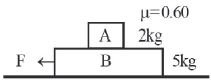
- 4Two block $(A)\,2\,kg$ and $(B)\,5\,kg$ rest one over the other on a smooth horizontal plane. The cofficient of static and dynamic friction between $(A)$ and $(B)$ is the same and equal to $0.60$. The maximum horizontal force that can be applied to $(B)$ in order that both $(A)$ and $(B)$ do not have any relative motion : $(g = 10\,m/s^2)$View Solution
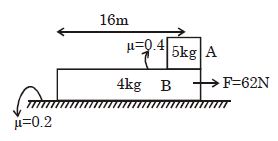
- 5Initially the whole system is at rest and now a force of $62\ N$ is applied on the block $B$ as shown in the figure. Find the time taken by $'A'$ to fall from the block $'B'$ ........... $\sec$View Solution
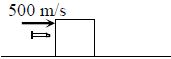
- 6A bullet of mass $20\, g$ travelling horizontally with a speed of $500 \,m/s$ passes through a wooden block of mass $10.0 \,kg$ initially at rest on a surface. The bullet emerges with a speed of $100\, m/s$ and the block slides $20 \,cm$ on the surface before coming to rest, the coefficient of friction between the block and the surface. $(g = 10\, m/s^2)$View Solution
- 7A block of mass $5\, kg$ is on a rough horizontal surface and is at rest. Now a force of $24\, N $is imparted to it with negligible impulse. If the coefficient of kinetic friction is $0.4$ and $g = 9.8\,m/{s^2}$, then the acceleration of the block is ........ $m/s^2$View Solution
- 8A block of mass $5$ kg lies on a rough horizontal table. A force of $19.6\, N$ is enough to keep the body sliding at uniform velocity. The coefficient of sliding friction isView Solution
- 9A particle of mass $m$ is executing uniform circular motion on a path of radius $r$. If $p$ is the magnitude of its linear momentum. The radial force acting on the particle isView Solution
- 10A particle has initial velocity $10\,\, m/s$. It moves due to constant retarding force along the line of velocity which produces a retardation of $5\,\, m/s^2$. ThenView Solution