A block of mass $5$ kg lies on a rough horizontal table. A force of $19.6\, N$ is enough to keep the body sliding at uniform velocity. The coefficient of sliding friction is
Easy
Download our app for free and get started
(c) ${\mu _k} = \frac{F}{R} = $$\frac{{19.6}}{{5 \times 9.8}} = \frac{2}{5} = 0.4$

Download our appand get started for free
Experience the future of education. Simply download our apps or reach out to us for more information. Let's shape the future of learning together!No signup needed.*
Similar Questions
- 1A mass of $100\, gm$ is tied to one end of a string $2 \,m$ long. The body is revolving in a horizontal circle making a maximum of $200$ revolutions per min. The other end of the string is fixed at the centre of the circle of revolution. The maximum tension that the string can bear is .......... $N$. (approximately)View Solution
- 2A coin is placed on a disc. The coefficient of friction between the coin and the disc is $\mu$. If the distance of the coin from the center of the disc is $r$, the maximum angular velocity which can be given to the disc, so that the coin does not slip away, is:View Solution
- 3The normal reaction $'{N}^{\prime}$ for a vehicle of $800\, {kg}$ mass, negotiating a turn on a $30^{\circ}$ banked road at maximum possible speed without skidding is $...\,\times 10^{3}\, {kg} {m} / {s}^{2}$ [Given $\left.\cos 30^{\circ}=0.87, \mu_{{s}}=0.2\right]$View Solution
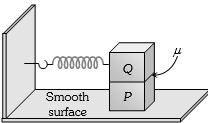
- 4$A$ block $P$ of mass m is placed on a frictionless horizontal surface. Another block Q of same mass is kept on $P$ and connected to the wall with the help of a spring of spring constant k as shown in the figure. ${\mu _s}$ is the coefficient of friction between$ P$ and $ Q$. The blocks move together performing SHM of amplitude $A$. The maximum value of the friction force between $P$ and $Q$ isView Solution
- 5The coefficient of friction $\mu $ and the angle of friction $\lambda $ are related asView Solution
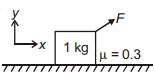
- 6A force $\vec{F}=\hat{i}+4 \hat{j}$ acts on the block shown. The force of friction acting on the block isView Solution
- 7A block of mass $10\; \mathrm{kg}$ is in contact against the inner wall of a hollow cylindow cylindrical drum of radius $1 \;\mathrm{m}$. The coeffident of friction between the block and the inner wall of the cylinder is $0.1$. The minimum angular velocity needed for the cylinder to keep the block stationary when the cylinder is vertical and rotating about its axis, will be: ......$rad/s$ $\left(g-10 m / s^{2}\right)$View Solution
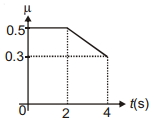
- 8A block is projected with speed $20 \,m / s$ on a rough horizontal surface. The coefficient of friction $(\mu)$ between the surfaces varies with time $(t)$ as shown in figure. The speed of body at the end of $4$ second will be ............ $m / s$ ( $g=$ $10 \,m / s ^2$ )View Solution
- 9Assuming the coefficient of friction between the road and tyres of a car to be $0.5$, the maximum speed with which the car can move round a curve of $40.0\, m$ radius without slipping, if the road is unbanked, should be ......... $m/s$View Solution
- 10Calculate the maximum acceleration (in $m s ^{-2}$) of a moving car so that a body lying on the floor of the car remains stationary. The coefficient of static friction between the body and the floor is $0.15$ $\left( g =10 m s ^{-2}\right)$.View Solution