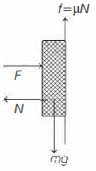
A girl holds a book of mass $m$ against a vertical wall with a horizontal force $F$ using her finger, so that the book does not move. The frictional force on the book by the wall is
KVPY 2012, Medium


Download our appand get started for free
Experience the future of education. Simply download our apps or reach out to us for more information. Let's shape the future of learning together!No signup needed.*
Similar Questions
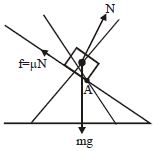
- 1View SolutionWhen a cube is in limiting equilibrium on an inclined plane and it is about to topple. The coefficient of friction between cube and plane is:-
- 2Two blocks $A$ and $B$ of masses $5 \,kg$ and $3 \,kg$ respectively rest on a smooth horizontal surface with $B$ over $A$. The coefficient of friction between $A$ and $B$ is $0.5$. The maximum horizontal force (in $kg$ wt.) that can be applied to $A$, so that there will be motion of $A$ and $B$ without relative slipping, isView Solution
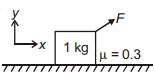
- 3A force $\vec{F}=\hat{i}+4 \hat{j}$ acts on the block shown. The force of friction acting on the block isView Solution
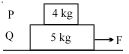
- 4The coefficient of friction between $4kg$ and $5\, kg$ blocks is $0.2$ and between $5kg$ block and ground is $0.1$ respectively. Choose the correct statementsView Solution
- 5In the figure shown, a block of weight $10 \,N$ resting on a horizontal surface. The coefficient of static friction between the block and the surface ${\mu _s} = 0.4$. A force of $3.5\, N$ will keep the block in uniform motion, once it has been set in motion. A horizontal force of $3 \,N$ is applied to the block, then the block willView Solution
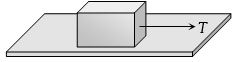
- 6A block of mass $M$ slides down on a rough inclined plane with constant velocity. The angle made by the incline plane with horizontal is $\theta$. The magnitude of the contact force will be.View Solution
- 7A girl holds a book of mass $m$ against a vertical wall with a horizontal force $F$ using her finger, so that the book does not move. The frictional force on the book by the wall isView Solution
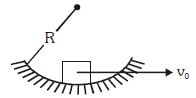
- 8A particle is projected with a speed ${v_0} = \sqrt {gR} $ . The coefficient of friction between the particle and the hemispherical plane is $\mu = 0.5$ . Then, the initial acceleration of the particle isView Solution
- 9A block of mass $10\; \mathrm{kg}$ is in contact against the inner wall of a hollow cylindow cylindrical drum of radius $1 \;\mathrm{m}$. The coeffident of friction between the block and the inner wall of the cylinder is $0.1$. The minimum angular velocity needed for the cylinder to keep the block stationary when the cylinder is vertical and rotating about its axis, will be: ......$rad/s$ $\left(g-10 m / s^{2}\right)$View Solution
- 10The coefficient of static friction between a wooden block of mass $0.5\, kg$ and a vertical rough wall is $0.2$ The magnitude of horizontal force that should be applied on the block to keep it adhere to the wall will be $N$ $\left[ g =10\, ms ^{-2}\right]$View Solution