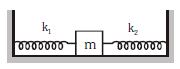
A body executes simple harmonic motion under the action of a force $F_1$ with a time period $(4/5)\, sec$. If the force is changed to $F_2$ it executes $SHM$ with time period $(3/5)\, sec$. If both the forces $F_1$ and $F_2$ act simultaneously in the same direction on the body, its time period (in $seconds$ ) is
Diffcult
Download our app for free and get started
$\mathrm{F}_{1}=-\mathrm{k}_{1} \mathrm{x}, \quad \mathrm{F}_{2}=-\mathrm{k}_{2} \mathrm{x}$
$\mathrm{f}_{1}=-\left(\frac{\mathrm{k}_{1}}{\mathrm{m}}\right) \mathrm{x} ; \quad \mathrm{f}_{2}=-\left(\frac{\mathrm{k}_{2}}{\mathrm{m}}\right) \mathrm{x}$
or $\quad \mathrm{f}_{1}=-\omega_{1}^{2} \mathrm{x}$ $\mathrm{f}_{2}=-\mathrm{w}_{2}^{2} \mathrm{x}$
Now, resultant force $\mathrm{F}=\mathrm{F}_{1}+\mathrm{F}_{2}=-\mathrm{k}_{1} \mathrm{x}-\mathrm{k}_{2} \mathrm{x}$
$\mathrm{Or}$ $-\mathrm{kx}=-\mathrm{k}_{1} \mathrm{x}-\mathrm{k}_{2} \mathrm{x}$
Or $\mathrm{k}=\mathrm{k}_{1}+\mathrm{k}_{2}$
Or $\mathrm{m} \omega^{2}=\mathrm{m} \omega_{1}^{2}+\mathrm{m} \omega_{2}^{2}$
Or $\omega^{2}=\omega_{1}^{2}+\omega_{2}^{2}$
Or $\left(\frac{2 \pi}{\mathrm{T}}\right)^{2}=\left(\frac{2 \pi}{\mathrm{T}_{1}}\right)^{2}+\left(\frac{2 \pi}{\mathrm{T}_{2}}\right)^{2}$
Or $\frac{1}{\mathrm{T}^{2}}=\frac{1}{\mathrm{T}_{1}^{2}}+\frac{1}{\mathrm{T}_{2}^{2}}$
$\mathrm{T}=\frac{\mathrm{T}_{1} \mathrm{T}_{2}}{\sqrt{\mathrm{T}_{1}^{2}+\mathrm{T}_{2}^{2}}}$
$=\frac{\frac{4}{5} \times \frac{3}{5}}{\sqrt{\left(\frac{4}{5}\right)^{2}+\left(\frac{3}{5}\right)^{2}}}=\frac{12}{25} \sec$

Download our appand get started for free
Experience the future of education. Simply download our apps or reach out to us for more information. Let's shape the future of learning together!No signup needed.*
Similar Questions
- 1View SolutionWhich of the following statements is not true ? In the case of a simple pendulum for small amplitudes the period of oscillation is
- 2A pendulum suspended from the ceiling of a train oscillates with a time period $2\,second$, when the train is accelerating at $10\,ms^{-2}$. What will be its time period when the train retards at $10\,ms^{-2}$ ? ..... $\sec$View Solution
- 3The maximum velocity and the maximum acceleration of a body moving in a simple harmonic oscillator are $2\,m/s$ and $4\,m/{s^2}.$ Then angular velocity will be ..... $rad/sec$View Solution
- 4The displacement of an object attached to a spring and executing simple harmonic motion is given by $ x= 2 \times 10^{-9}$ $ cos$ $\;\pi t\left( m \right)$ .The time at which the maximum speed first occurs isView Solution
- 5A vibratory motion is represented by $x = 2A\,\cos \omega t + A\,\cos \,\left( {\omega t + \frac{\pi }{2}} \right) + A\,\cos \,\left( {\omega t + \pi } \right)$ $ + \frac{A}{2}\,\cos \left( {\omega t + \frac{{3\pi }}{2}} \right)$. The resultant amplitude of the motion isView Solution
- 6The $x-t$ graph of a particle performing simple harmonic motion is shown in the figure. The acceleration of the particle at $t=2 s$ is :View Solution
- 7A ring is suspended from a point $S$ on its rim as shown in the figure. When displaced from equilibrium, it oscillates with time period of $1\,second.$ The radius of the ring is ..... $m$ (take $g = \pi ^2$ )View Solution

- 8$Y = A \sin \left(\omega t +\phi_{0}\right)$ is the time-displacement equation of a SHM. At $t=0$ the displacement of the particle is $Y =\frac{ A }{2}$ and it is moving along negative $x$ -direction. Then the initial phase angle $\phi_{0}$ will be ...... .View Solution
- 9The displacement of a particle varies according to the relation $x = 3 \sin 100 \, t + 8 \cos ^2 50\,t $. Which of the following is/are correct about this motion .View Solution
- 10A block of mass $m$ is attached to two springs of spring constants $k_1$ and $k_2$ as shown in figure. The block is displaced by $x$ towards right and released. The velocity of the block when it is at $x/2$ will beView Solution