MCQ
A body executing simple harmonic motion has a maximum acceleration equal to $ 24\,metres/se{c^2} $ and maximum velocity equal to $ 16\;metres/sec $. The amplitude of the simple harmonic motion is
  • $\frac{{32}}{3}\,metres$
  • B
    $\frac{3}{{32}}\,metres$
  • C
    $\frac{{1024}}{9}\,metres$
  • D
    $\frac{{64}}{9}\,metres$

Answer

Correct option: A.
$\frac{{32}}{3}\,metres$
a
(a) Maximum velocity $ = a\omega = 16$ 

Maximum acceleration $ = {\omega ^2}a = 24$ 

$ \Rightarrow a = \frac{{{{(a\omega )}^2}}}{{{\omega ^2}a}} = \frac{{16 \times 16}}{{24}} = \frac{{32}}{3}m$

Need a full question paper?

Generate a complete, print-ready paper with questions like this in minutes — across 16+ boards, with answer keys.

Start Generating Free

Similar questions

A bullet is fired from a cannon with velocity $500 \,m/s$. If the angle of projection is ${15^o}$ and $g = 10m/{s^2}$. Then the range is
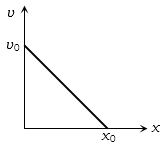
The given graph shows the variation of velocity with displacement. Which one of the graph given below correctly represents the variation of acceleration with displacement
A gas at absolute temperature $300\,K$ has pressure $= 4 \times 10^{-10}\,N /m^2$  . Boltzmann constant, $k = 1.38 \times 10^{-23}\,J / K$ . The number of molecules per $cm^3$ is of the order of
A pump draws water from a tank which is at $2.5\; m$ down from outlet and issues it from the end of a hose which the water is drawn. The cross sectional area is $10\; cm ^{2}$, and the water leaves the end of the hose at a speed of $5\; m / s$. What is the rate at which the pump is working ?
A ball strikes against the floor and returns with double the velocity; in which type of collision is it possible?
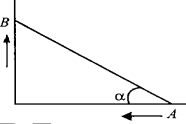
Two particles $A$ and $B$ are connected by rigid rod $A B$. The rod slides along perpendicular rails as shown here. The velocity of $A$ to the left is $10\; m / s$. What is the velocity of $B$(in $m/s$) when angle $\alpha=60^{\circ}$?
An open pipe is in resonance in its $2^{nd}$ harmonic with tuning fork of frequency ${f_1}$. Now it is closed at one end. If the frequency of the tuning fork is increased slowly from ${f_1}$ then again a resonance is obtained with a frequency ${f_2}$. If in this case the pipe vibrates ${n^{th}}$ harmonics then
The temperature of a liquid drops from $365K$ to $361 K$ in $2$ minutes. Find the time during which temperature of the liquid drops from $344\;K$ to $342K$. Temperature of room is $293\;K$  ....... $\sec$
An ideal gas, initially in state $\left( P _{12}, V _1, T _1\right)$ is expanded isobarically to $\left( P _{12}, V _2, T _2\right)$, then adiabatically $\left( P _{34}, V _3, T _3\right)$. It is then contracted isobarically to $\left( P _{34}, V _4, T _4\right)$ and finally adiabatically back to the initial state. The efficiency of this cycle is
Second harmonic of open pipe is: