MCQ
A body is moved from rest along $a$ straight line by $a$ machine delivering constant power. The ratio of displacement and velocity $(s/v)$ varies with time $t$ as :

  • B

  • C

  • D

Answer

Correct option: A.

a
$w=\Delta K \cdot E \Rightarrow P t=\frac{1}{2} m v^{2}, v=\sqrt{\frac{2 P t}{m}}$

$\frac{d s}{d t}=\sqrt{\frac{2 P}{m}} t^{1 / 2}$

Need a full question paper?

Generate a complete, print-ready paper with questions like this in minutes — across 16+ boards, with answer keys.
Start Generating Free

Similar questions

When objects at different distances are seen by the eye, which of the following remain constant?
Two moles of ideal helium gas are in a rubber balloon at $30^{\circ} C$. The balloon is fully expandable and can be assumed to require no energy in its expansion. The temperature of the gas in the balloon is slowly changed to $35^{\circ} C$. The amount of heat required in raising the temperature is nearly (take $R =8.31 J / mol$. $K$)
stone is tied to one end of a string $50\, cm$ long is whirled in a horizontal circle with a constant speed. If the stone makes $10$ revolutions in $20\, s$, what is the magnitude of acceleration of the stone ......... $cm/s^2$
If the absorption and reflection co-efficients of a surface of a body are $0.4$ and $0.6$ respectively, then
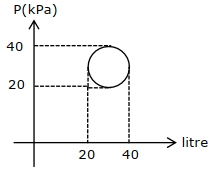
In the reported figure, heat energy absorbed by a system in going through a cyclic process is $......\,\pi J$
A uniform string resonates with a tuning fork, at a maximum tension of $32 \,N$. If it is divided into two segments by placing a wedge at a distance one-fourth of length from one end, then to resonance with same frequency the maximum value of tension for string will be ........... $N$
The displacement of a particle is given by $\overrightarrow{\text{r}}=\text{A}\big(\overrightarrow{\text{i}}\cos\omega\text{t}+\overrightarrow{\text{j}}\sin\omega\text{t}\big)$ The motion of the particle is:
Choose the correct option.
At nodes in stationary waves:
Surface of the lake is at $2°C$ . Find the temperature of the bottom of the lake..... $^oC$