A body of density ${d_1}$ is counterpoised by $Mg$ of weights of density ${d_2}$ in air of density $d$. Then the true mass of the body is
Medium


Download our appand get started for free
Experience the future of education. Simply download our apps or reach out to us for more information. Let's shape the future of learning together!No signup needed.*
Similar Questions
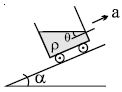
- 1A fluid container is containing a liquid of density $\rho $ is accelerating upward with acceleration a along the inclined place of inclination $\alpha$ as shown. Then the angle of inclination $ \theta $ of free surface is :View Solution
- 2The reading of pressure metre attached with a closed pipe is $4.5 \times 10^4 \mathrm{~N} / \mathrm{m}^2$. On opening the valve, water starts flowing and the reading of pressure metre falls to $2.0 \times 10^4 \mathrm{~N} / \mathrm{m}^2$. The velocity of water is found to be $\sqrt{\mathrm{V}} \mathrm{m} / \mathrm{s}$. The value of $\mathrm{V}$ is__________View Solution
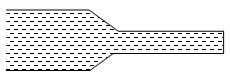
- 3Water flows through a frictionless duct with a cross-section varying as shown in fig. Pressure $p$ at points along the axis is represented byView Solution
- 4A small wooden ball of density $ \rho$ is immersed in water of density $\sigma $ to depth $h $ and then released. The height $H$ above the surface of water up to which the ball will jump out of water isView Solution
- 5A ball of relative density $0.8$ falls into water from a height of $2$ $m$. The depth to which the ball will sink is ........ $ m$ (neglect viscous forces) :View Solution
- 6View SolutionFrom amongst the following curves, which one shows the variation of the velocity v with time t for a small sized spherical body falling vertically in a long column of a viscous liquid
- 7A log of wood of mass $120 Kg$ floats in water. The weight that can be put on the raft to make it just sink, should be ....... $Kg$ (density of wood = $600 Kg/m^3$)View Solution
- 8Two solids $A$ and $ B$ float in water. It is observed that $A$ floats with half its volume immersed and $B$ floats with $2/3$ of its volume immersed. Compare the densities of $A$ and $B$View Solution
- 9An object with uniform density $\rho$ is attached to a spring that is known to stretch linearly with applied force as shown below.When the spring object system is immersed in a liquid of density $\rho_1$ as shown in the above figure, the spring stretches by an amount $x_1\left(\rho > \rho_1\right)$. When the experiment is repeated in a liquid of density $\left(\rho_2 < \rho_1\right)$, the spring stretches by an amount $x_2$. Neglecting any buoyant force on the spring, the density of the object isView Solution
- 10A $U-$tube contains water and methylated spirit separated by mercury. The mercury columns in the two arms are in level with $10.0\; cm$ of water in one arm and $12.5\; cm $ of spirit in the other. if $15.0\; cm$ of water and spirit each are further poured into the respective arms of the tube, what is the difference in the levels (in $cm$) of mercury in the two arms?View Solution
(the specific gravity of spirit is $0.8.)$