A log of wood of mass $120 Kg$ floats in water. The weight that can be put on the raft to make it just sink, should be ....... $Kg$ (density of wood = $600 Kg/m^3$)
Diffcult


Download our appand get started for free
Experience the future of education. Simply download our apps or reach out to us for more information. Let's shape the future of learning together!No signup needed.*
Similar Questions
- 1A sphere is dropped under gravity through a fluid of viscosity $\eta$ . If the average acceleration is half of the initial acceleration, the time to attain the terminal velocity is ($\rho$ = density of sphere ; $r$ = radius)View Solution
- 2A liquid is kept in a cylindrical vessel. When the vessel is rotated about its axis, the liquid rises at its sides. If the radius of the vessel is $0.05\,\, m$ and the speed of rotation is $2$ revolutions per second, the difference in the heights of the liquid at the centre and at the sides of the vessels will be ...... $cm.$ $($ take $g = 10\,\, ms^{-2}$ and $\pi^2 = 10)$View Solution
- 3The reading of spring balance when a block is suspended from it in air, is $60\,N$. This reading is changed to $40\, N$ when the block is immersed in water. The specific density of the block isView Solution
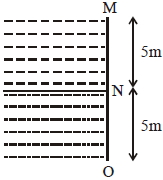
- 4Two liquids of densities $\rho_{1}$ and $\rho_{2}\left(\rho_{2}=2 \rho_{1}\right)$ are filled up behind a square wall of side $10\; \mathrm{m}$ as shown in figure. Each liquid has a height of $5 \;\mathrm{m} .$ The ratio of the forces due to these liquids exerted on upper part $MN$ to that at the lower pait $NO$ is (Assume that the liquids are not mixing)View Solution
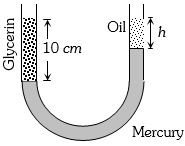
- 5A vertical $U-$ tube of uniform inner cross section contains mercury in both sides of its arms. A glycerin (density = $1.3 g/cm^3$) column of length $10 $ $cm $ is introduced into one of its arms. Oil of density $0.8 gm/cm^3$ is poured into the other arm until the upper surfaces of the oil and glycerin are in the same horizontal level. Find the length of the oil column ........ $cm$. Density of mercury = $13.6 g/cm^3$View Solution
- 6A liquid is flowing in a horizontal uniform capillary tube under a constant pressure difference $P$. The value of pressure for which the rate of flow of the liquid is doubled when the radius and length both are doubled isView Solution
- 7View SolutionThe displacement of a ball falling from rest in a viscous medium is platted against time. Choose a possible option
- 8A submarine experiences a pressure of $5.05\times 10^6\,Pa$ at a depth of $d_1$ in a sea. When it goes further to a depth of $d_2,$ it experiences a pressure of $8.08\times 10^6\,Pa.$ Then $d_2 -d_1$ is approximately ........ $m$ (density of water $= 10^3\,kg/m^3$ and acceleration due to gravity $= 10\,ms^{-2}$ )View Solution
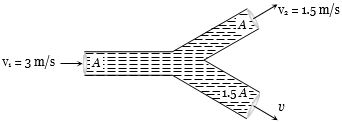
- 9An incompressible liquid flows through a horizontal tube as shown in the following fig. Then the velocity $ v$ of the fluid is .......$m/s$View Solution
- 10If solid will break under pressure greater than $13\ atm$ and that solid has a specific gravity of $4$ , what is the maximum height of a cylinder made from the solid that can be built at the earth's surface ? (Note: $1\ atm$ = $10^5\ Pa$ .) ......... $m$View Solution