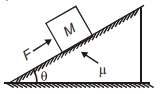
A body of mass $10\, kg$ is lying on a rough plane inclined at an angle of $30^o$ to the horizontal and the coefficient of friction is $0.5$. the minimum force required to pull the body up the plane is ........ $N$
Medium
Download our app for free and get started
(b) $F = mg(\sin \theta + \mu \cos \theta )$
$ = 10 \times 9.8(\sin 30^\circ + 0.5\cos 30^\circ ) = 91.4\;N$.

Download our appand get started for free
Experience the future of education. Simply download our apps or reach out to us for more information. Let's shape the future of learning together!No signup needed.*
Similar Questions
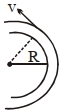
- 1A modern grand-prix racing car of mass $m$ is travelling on a flat track in a circular arc of radius $R$ with a speed $v$. If the coefficient of static friction between the tyres and the track is $\mu_{s},$ then the magnitude of negative lift $F_{L}$ acting downwards on the car isView Solution
(Assume forces on the four tyres are identical and $g =$ acceleration due to gravity)
- 2A $60\, kg$ body is pushed with just enough force to start it moving across a floor and the same force continues to act afterwards. The coefficient of static friction and sliding friction are $0.5$ and $0.4$ respectively. The acceleration of the body is ........ $m/{s^2}$View Solution
- 3A body of mass $'m'$ is launched up on a rough inclined plane making an angle of $30^{\circ}$ with the horizontal. The coeffcient of friction between the body and plane is $\frac{\sqrt{x}}{5}$ if the time of ascent is half of the time of descent. The value of $x$ is ..... .View Solution
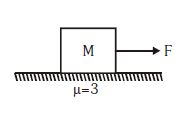
- 4A block of mass $M$ placed on rough surface of coefficient of friction equal to $3$ . If $F$ is the $(4/5)$ of the minimum force required to just move. Find out the force exerted by ground on the blockView Solution
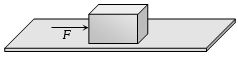
- 5A block of mass $2 \,kg$ is kept on the floor. The coefficient of static friction is $0.4$. If a force F of $2.5$ Newtons is applied on the block as shown in the figure, the frictional force between the block and the floor will be ........ $N$View Solution
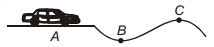
- 6View SolutionA vehicle is moving on a track with constant speed as shown in figure. The apparent weight of the vehicle is
- 7A block of mass $m$ slides down the plane inclined at angle $30^{\circ}$ with an acceleration $\frac{ g }{4}$. The value of coefficient of kinetic friction will be :View Solution
- 8A block (mass $=M kg$ ) is placed on a rough inclined plane. A force $F$ is applied parallel to the inclined (as shown in figure) such that it just starts moving upward. The value of $F$ isView Solution
- 9If the radius of curvature of the path of two particles of same masses are in the ratio $1 : 2$, then in order to have constant centripetal force, their velocity, should be in the ratio ofView Solution
- 10$Assertion$ : On a rainy day it is difficult to drive a car or bus at high speed.View Solution
$Reason$ : The value of coefficient of friction is lowered due to wetting of the surface