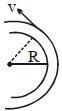
If the radius of curvature of the path of two particles of same masses are in the ratio $1 : 2$, then in order to have constant centripetal force, their velocity, should be in the ratio of
Medium


Download our appand get started for free
Experience the future of education. Simply download our apps or reach out to us for more information. Let's shape the future of learning together!No signup needed.*
Similar Questions
- 1If for an inclined plane coefficient of static friction is ${\mu _s} = \frac{3}{4}$, then for the inclined plane angle of repose will be ........ $^o$View Solution
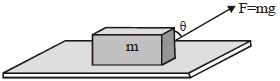
- 2A force $f$ is acting on a block of mass $m$. Coefficient of friction between block and surface is $\mu$. The block can be pulled along the surface if :-View Solution
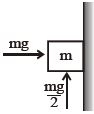
- 3View SolutionA block pressed against the vertical wall is in equilibrium. The minimum coefficient of friction is:-
- 4A block of mass $50 \,kg$ can slide on a rough horizontal surface. The coefficient of friction between the block and the surface is $0.6$. The least force of pull acting at an angle of $30^°$ to the upward drawn vertical which causes the block to just slide is ........ $N$View Solution
- 5View SolutionWhen a body is moving on a surface, the force of friction is called
- 6A block of wood resting on an inclined plane of angle $30^o$, just starts moving down. If the coefficient of friction is $0.2$, its velocity (in $ms^{-1}$) after $5\, seconds$ is : $(g = 10\, ms^{-2})$View Solution
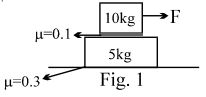
- 7When $F = 2N$, the frictional force between $5 kg$ block and ground is ...... $N$View Solution
- 8Two masses $M$ and $m$ are attached to a vertical axis by weightless threads of combined length $l$. They are set in rotational motion in a horizontal plane about this axis with constant angular velocity $\omega $. If the tensions in the threads are the same during motion, the distance of $M$ from the axis isView Solution
- 9A modern grand-prix racing car of mass $m$ is travelling on a flat track in a circular arc of radius $R$ with a speed $v$. If the coefficient of static friction between the tyres and the track is $\mu_{s},$ then the magnitude of negative lift $F_{L}$ acting downwards on the car isView Solution
(Assume forces on the four tyres are identical and $g =$ acceleration due to gravity)
- 10A block is projected upwards on an inclined plane of inclination $37^o$ along the line of greatest slope of $\mu = 0.5$ with velocity of $5 m/s$. The block $1^{st}$ stops at $a$ distance of .......... $m$ from starting pointView Solution