Two bodies of equal masses revolve in circular orbits of radii ${R_1}$ and ${R_2}$ with the same period. Their centripetal forces are in the ratio
Easy


Download our appand get started for free
Experience the future of education. Simply download our apps or reach out to us for more information. Let's shape the future of learning together!No signup needed.*
Similar Questions
- 1A conveyor belt is moving at a constant speed of $2\, m s^{-1}$. A box is gently dropped on it. The coefficient of friction between them is $\mu = 0.5.$ The distance that the box will move relative to belt before coming to rest on it, taking $g = 10\, m s^{-2},$ is ........... $m$View Solution
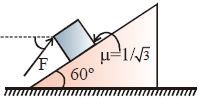
- 2The minimum value of $‘F’$ so that block is in equilibrium isView Solution
- 3A uniform chain of length $L$ which hanges partially from a table, is kept in equilibrium by friction. The maximum length that can withstand without slipping is $l$ , then coefficient of friction between the table and the chain isView Solution
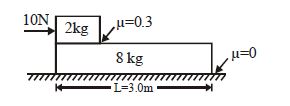
- 4Determine the time in which the smaller block reaches other end of bigger block in the figure. $(g = 10\ m s^{-2})$ .......... $\sec$View Solution
- 5View SolutionWhich of the following is a self adjusting force?
- 6View SolutionMaximum force of friction is called
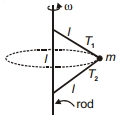
- 7In the figure, a ball of mass $m$ is tied with two strings of equal length as shown. If the rod is rotated with angular velocity $\omega$, thenView Solution
- 8In figure, two blocks $M$ and $m$ are tied together with an inextensible and light string. The mass $M$ is placed on a rough horizontal surface with coefficient of friction $\mu$ and the mass $m$ is hanging vertically against a smooth vertical wall. The pulley is frictionless. Choose the correct statement $(s)$View Solution

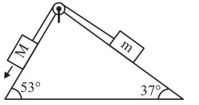
- 9In the given arrangement of a doubly inclined plane two blocks of masses $\mathrm{M}$ and $\mathrm{m}$ are placed. The blocks are connected by a light string passing over an ideal pulley as shown. The coefficient of friction between the surface of the plane and the blocks is $0.25$ . The value of $\mathrm{m}$, for which $\mathrm{M}=10$ $\mathrm{kg}$ will move down with an acceleration of $2 \mathrm{~m} / \mathrm{s}^2$, is : (take $\mathrm{g}=10 \mathrm{~m} / \mathrm{s}^2$ and $\left.\tan 37^{\circ}=3 / 4\right)$View Solution
- 10A body of mass $\mathrm{m}$ is kept on a rough horizontal surface (coefficient of friction $=\mu$ ) A horizontal force is applied on the body, but it does not move. The resultant of normal reaction and the frictional force acting on the object is given by $\mathrm{F},$ where $\mathrm{F}$ isView Solution