A body takes $5$ minutes to cool from $90^oC$ to $60^oC$. If the temperature of the surroundings is $20^oC$, the time taken by it to cool from $60^oC$ to $30^oC$ will be ...... $\min.$
Medium


Download our appand get started for free
Experience the future of education. Simply download our apps or reach out to us for more information. Let's shape the future of learning together!No signup needed.*
Similar Questions
- 1Two rods, one made of copper and the other steel of the same length and cross-sectional area are joined together. The thermal conductivity of copper is $385 \,Js ^{-1} m ^{-1} K ^{-1}$ and steel is $50 \,Js ^{-1} m ^{-1} K ^{-1}$. If the copper end is held at $100^{\circ} C$ and the steel end is held at $0^{\circ} C$, the junction temperature is ........... $C$ (Assuming no other heat losses)View Solution
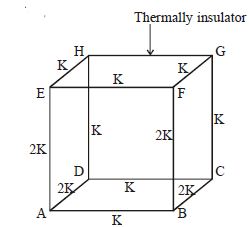
- 2Find effective thermal resistance between $A$ & $B$ of cube made up of $12$ rods of same dimensions and shown given thermal conductivity. [ $l =$ length of rod, $a =$ cross section area of rod]View Solution
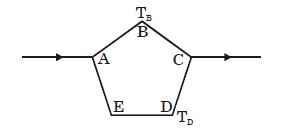
- 3$ABCDE$ is a regular pentagon of uniform wire. The rate of heat entering at $A$ and leaving at $C$ is equal. $T_B$ and $T_D$ are temperature of $B$ and $D$ . Find the temperature $T_C$View Solution
- 4A hot body, obeying Newton's law of cooling is cooling down from its peak value $80\,^oC$ to an ambient temperature of $30\,^oC$ . It takes $5\, minutes$ in cooling down from $80\,^oC$ to $40\,^oC$. ........ $\min.$ will it take to cool down from $62\,^oC$ to $32\,^oC$ ? (Given $ln\, 2\, = 0.693, ln\, 5\, = 1.609$)View Solution
- 5View SolutionThe amount of radiation emitted by a perfectly black body is proportional to
- 6A container with $1 kg$ of water in it is kept in sunlight, which causes the water to get warmer than the surroundings. The average energy per unit time per unit area received due to the sunlight is $700 Wm ^{-2}$ and it is absorbed by the water over an effective area of $0.05 m ^2$. Assuming that the heat loss from the water to the surroundings is governed by Newton's law of cooling, the difference (in ${ }^{\circ} C$ ) in the temperature of water and the surroundings after a long time will be. . . . . . . . (Ignore effect of the container, and take constant for Newton's law of cooling $=0.001 s ^{-1}$, Heat capacity of water $\left.=4200 J kg ^{-1} K ^{-1}\right)$View Solution
- 7Ice starts forming in lake with water at ${0^o}C$ and when the atmospheric temperature is $ - {10^o}C$. If the time taken for $1 \;cm$ of ice be $7$ hours, then the time taken for the thickness of ice to change from $1\; cm$ to $2\; cm$ isView Solution
- 8Wires $A$ and $B$ have identical lengths and have circular cross-sections. The radius of $A$ is twice the radius of $B$ $i.e.$ ${r_A} = 2{r_B}$. For a given temperature difference between the two ends, both wires conduct heat at the same rate. The relation between the thermal conductivities is given byView Solution
- 9Two bodies $A$ and $B$ of same mass, area and surface finish with specific heats $S_A$ and $S_B\left(S_A > S_B\right)$ are allowed to cool for given temperature range. Temperature varies with time as ..........View Solution
- 10View SolutionWhen fluids are heated from the bottom, convection currents are produced because