A body takes just twice the time as long to slide down a plane inclined at $30^o$ to the horizontal as if the plane were frictionless. The coefficient of friction between the body and the plane is
Difficult
Download our app for free and get started
(a)$\mu = \tan \theta \left( {1 - \frac{1}{{{n^2}}}} \right) = \tan 30^°\left( {1 - \frac{1}{{{2^2}}}} \right) = \frac{{\sqrt 3 }}{4}$

Download our appand get started for free
Experience the future of education. Simply download our apps or reach out to us for more information. Let's shape the future of learning together!No signup needed.*
Similar Questions
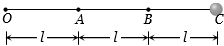
- 1Three identical particles are joined together by a thread as shown in figure. All the three particles are moving in a horizontal plane. If the velocity of the outermost particle is $v_0$, then the ratio of tensions in the three sections of the string isView Solution
- 2A block of mass $1\,kg$ lies on a horizontal surface in a truck. The coefficient of static friction between the block and the surface is $0.6$ . If the acceleration of the truck is $5\,m\,s^{-2}$ . The frictional force acting on the block is ........ $N$View Solution
- 3A block of weight $W$ rests on a horizontal floor with coefficient of static friction $\mu .$ It is desired to make the block move by applying minimum amount of force. The angle $\theta $ from the horizontal at which the force should be applied and magnitude of the force $F$ are respectively.View Solution
- 4A car is negotiating a curved road of radius $R$. The road is banked at an angle $\theta .$ The coefficient of friction between the tyres of the car and the road is $\mu _s.$ The maximum safe velocity on this road isView Solution
- 5A block of mass $M$ slides down on a rough inclined plane with constant velocity. The angle made by the incline plane with horizontal is $\theta$. The magnitude of the contact force will be.View Solution
- 6A conveyor belt is moving at a constant speed of $2\, m s^{-1}$. A box is gently dropped on it. The coefficient of friction between them is $\mu = 0.5.$ The distance that the box will move relative to belt before coming to rest on it, taking $g = 10\, m s^{-2},$ is ........... $m$View Solution
- 7A railway line is taken round a circular arc of radius $1000\ m$, and is banked by raising the outer rail $h\ m$ above the inner rail. If the lateral force on the inner rail when a train travels round the curve at $10 \ ms^{-1}$ is equal to the lateral force on the outer rail when the train's speed is $20\ ms^{-1}$. The value of $4g\ tan\theta$ is equal to : (The distance between the rails is $1.5 \ m$).View Solution
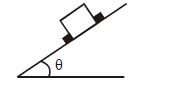
- 8View SolutionWhich of the following is self adjusting in nature?
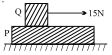
- 9$A$ long plank $P$ of the mass $5\, kg$ is placed on a smooth floor. On $P$ is placed a block $Q$ of mass $2\, kg$. The coefficient of friction between $P$ and $Q$ is $0.5$. If a horizontal force $15N$ is applied to $Q$, as shown, and you may take $g$ as $10N/kg.$View Solution
- 10A cyclist turns around a curve at $15\, miles/hour$. If he turns at double the speed, the tendency to overturn isView Solution