MCQ
A body will have uniform acceleration if its:
  • A
    Speed changes at uniform rate
  • Velocity changes at uniform rate
  • C
    Speed changes at non - uniform rate
  • D
    Velocity remains constant

Answer

Correct option: B.
Velocity changes at uniform rate
$b.$ Velocity changes at uniform rate
Explanation:
If the velocity of an object changes at a uniform rate, then the acceleration that causes the change in velocity is called uniform acceleration or constant acceleration.
For example, the force of gravity imparts an acceleration uniformly which is called acceleration due to gravity.

Need a full question paper?

Generate a complete, print-ready paper with questions like this in minutes — across 16+ boards, with answer keys.
Start Generating Free

Similar questions

The maximum range of a bullet fired from a toy pistol mounted on a car at rest is $R_0= 10\, m$. What will be the acute angle of inclination of the pistol for maximum range when the car is moving in the direction of firing with uniform velocity $v = 20\, m/s$, on a horizontal surface ......... $^o.$ $(g = 10\, m/s^2)$
A river is flowing from west to east at a speed of 5 metres per minute. A man on the south bank of the river, capable of swimming at 10 metres per minute in still water, wants to swim across the river in the shortest time. He should swim in a direction:
Two bodies are thrown up at angles of $45^o $ and $60^o $, respectively, with the horizontal. If both bodies attain same vertical height, then the ratio of velocities with which these are thrown is
A bubble of $8$ mm diameter is formed in the air. The surface tension of soap solution is $30$ dynes/cm. The excess pressure inside the bubble is ........ $dynes/cm^2$
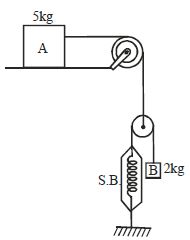
If all the pulleys are massless and string is ideal, find the reading of spring balance
The angular speed of earth, so that the object on equator may appear weightless, is $(g = 10\,m/{s^2}$, radius of earth $6400\, km$)
A mass $1\, kg$ is suspended by a thread. It is

$(i)\,$ lifted up with an acceleration $4.9\,m/{s^2}$

$(ii) \,$lowered with an acceleration $4.9\,m/{s^2}$.

The ratio of the tensions is

In a longitudinal wave, the elastic property of the constituents of the medium that determines the stress under compressional strain is:
The motion of a particle as per $x=Asin \omega t + Bcos\omega t$ is :-
A particle executes simple harmonic motion with an amplitude of $4 \mathrm{~cm}$. At the mean position, velocity of the particle is $10 \mathrm{~cm} / \mathrm{s}$. The distance of the particle from the mean position when its speed becomes $5 \mathrm{~cm} / \mathrm{s}$ is $\sqrt{\alpha} \mathrm{cm}$, where $\alpha=$____________.